
3.1 MÉTODO AMENORREA DE LA LACTANCIA (MELA o MAL)
El método de amenorrea de la lactancia (MELA) es un método anticonceptivo en el que se informa y apoya a la madre sobre cómo utilizar la lactancia para la anticoncepción. La lactancia sin alimentación complementaria retrasa el retorno de la fertilidad y los períodos menstruales, lo que constituye una protección normal (fisiológica) frente al embarazo. De forma más detallada, consiste en una lactancia exclusiva con tomas frecuentes espaciadas como mucho de 4 a 6 horas, incluso durante la noche y siempre que no haya menstruación.
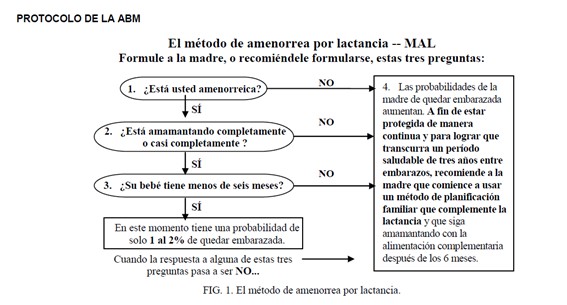
El protocolo nº 13 de la ABM (American Breastfeeding Medicine) presenta el método MELA o MAL como un algoritmo (Fig. 1) e incluye tres criterios para definir el período de más bajo riesgo de embarazo. Si no se cumpliera con uno de estos criterios, las mujeres deben iniciar inmediatamente otro método. Se le hacen las siguientes tres preguntas a la madre:
- “¿Está usted amenorreica?”, lo que significa que no ha menstruado ni ha tenido ningún sangrado de más de 2 días de duración (descontando el sangrado durante los primeros dos meses).
- “¿Está amamantando completamente o casi completamente?”. Esto incluye no dar a su bebé ningún alimento ni líquido complementario además de la leche materna (más de una o dos veces por semana).
- “¿Su bebé tiene menos de 6 meses de edad?”
Si responde “sí” a las tres preguntas, reúne los requisitos para este método anticonceptivo. Si cualquiera de las tres preguntas anteriores se responde con un “no”, entonces aumentan sus probabilidades de quedarse embarazada y es preciso aconsejarle comenzar con otra forma de anticoncepción para evitar un embarazo. Si la madre está interesada y cumple los criterios para seguir el método MAL/MELA, deberá repasar estas tres preguntas periódicamente. Los médicos deben asegurarse de que haya escogido su siguiente método de anticoncepción y que lo tenga a mano o sepa cómo obtenerlo si fuera un implante o un dispositivo intrauterino (DIU).
Una revisión de la bibliografía de Cochrane (Van der Wijden 2003) llegó a la conclusión de que los índices de fertilidad son bajos entre mujeres amenorreicas dedicadas a una lactancia completa. En estudios controlados del MAL, los índices de embarazo durante 6 meses variaron entre 0.45% y 2.45%. En seis estudios no controlados de usuarias del MAL, los índices de embarazo variaron entre 0% y 7.5%. La OMS llevó a cabo un ensayo prospectivo sobre la amenorrea durante la lactancia y el retorno de la fertilidad; si bien este no fue un estudio de mujeres que elegían y empleaban el MAL, las conclusiones confirmaron el potencial fisiológico de eficacia alta tal como se observó en los ensayos del MAL (OMS 1999, I&II). Posteriormente, los estudios sobre el uso del método descubrieron sistemáticamente un índice de embarazo a 6 meses que promediaba el 2% (Hatcher 2011).
3.2 ANTICONCEPTIVOS MECÁNICOS
3.2.1 Preservativo
El método de barrera más usado es el preservativo, el preservativo externo tiene una eficacia de alrededor del 98% con uso perfectoy unatasa de fallo del 13% en uso típico. Sí conviene remarcar que es el único método que además reduce el riesgo de ITS (CDC 2026).
Diafragma
El diafragma es un método muy poco usado en España. Requiere tomar medidas en la consulta ginecológica para encargarlo, aprender a usarlo correctamente y, para que sea más eficaz, se recomendaba usarlo junto con una crema espermicida.
Dispositivo intrauterino (DIU)
El DIU es uno de los anticonceptivos más frecuentemente utilizados en el mundo. El DIU se coloca en la consulta ginecológica, puede colocarse en cualquier momento del posparto, incluso de forma inmediata, también tras cesárea y durante lactancia, siempre que no haya sepsis posparto; cabe añadir que su expulsión es más frecuente cuando se coloca en el posparto inmediato (Curtis 2024).
El DIU funciona creando un ambiente adverso a los espermatozoides y a la posible implantación de un óvulo fecundado, ya que provoca una reacción inflamatoria a cualquier cuerpo extraño. A algunas mujeres les causa reglas más largas y dolorosas.
Hay dos tipos de estos dispositivos: DIU hormonales que liberan levonorgestrel y los DIU no hormonales de cobre. Tienen distintos perfiles de efectos secundarios.
Los DIU liberadores de levonorgestrel están asociados con una reducción del flujo menstrual, si bien en torno al momento de la inserción las mujeres suelen experimentar un sangrado irregular.
En un estudio que comparó los resultados de lactancia en mujeres asignadas aleatoriamente para recibir un DIU de cobre u hormonal entre las 6 y las 8 semanas después del parto, los autores no encontraron ninguna diferencia en la duración total de la lactancia, en el crecimiento de los bebés ni el desarrollo hasta 1 año después del parto (Shaamash 2005). No obstante, en un análisis secundario de un ensayo controlado aleatorizado que comparaba mujeres que se colocaron un DIU de levonorgestrel inmediatamente después del parto con otras que se lo colocaron de 6 a 8 semanas después del parto, la colocación temprana del DIU de levonorgestrel se asoció con índices de lactancia inferiores (Chen 2011); en el grupo de colocación tardía, cuatro mujeres recibieron ADMP antes de su consulta a las 6 semanas.
En relación con los estudios del DIU de cobre, se ha asociado a un aumento de dismenorreas y menorragias. Por otro lado, no se detectaron cambios en la leche ni en los niveles de cobre en suero (Cunha 2001).
Las complicaciones relacionadas con el dispositivo en sí incluyen perforación uterina, fallo (embarazo), imposibilidad de visualizar los hilos en el cuello del útero, secreción vaginal, infección, dolor, que la pareja sienta los hilos, mala ubicación (que podría requerir de un procedimiento quirúrgico para retirar el DIU) y expulsión (de 2 a 10% dentro del primer año). Los datos sugieren que existe un mayor riesgo de perforación cuando se coloca cualquiera de los DIU a mujeres que amamantan.
Una revisión sistemática reciente sugirió que los DIU siguen siendo una opción anticonceptiva a largo plazo reversible para mujeres que amamantan y que tuvieron a sus bebés por cesárea.
3.3 ANTICONCEPTIVOS HORMONALES
3.3.1 Levonorgestrel
Los anticonceptivos con solo progestágeno —entre ellos el levonorgestrel— continúan considerándose los métodos hormonales de elección durante la lactancia. La evidencia actualmente disponible indica que, en general, no se asocian con efectos clínicamente relevantes sobre la composición de la leche, el crecimiento y desarrollo del lactante ni la duración de la lactancia, aunque debe reconocerse que una parte de los estudios presenta limitaciones metodológicas. En este contexto, el CDC 2024 clasifica en mujeres lactantes a las píldoras solo con progestágeno, los implantes y el acetato de medroxiprogesterona de depósito (DMPA) como métodos aceptables desde el posparto temprano, si bien el DMPA merece una valoración más cautelosa en algunos escenarios por su posible asociación con un incremento adicional del riesgo tromboembólico venoso en el posparto (Nguyen 2024, Lactmed 2026, OMS 2025).
En el caso específico del levonorgestrel, su transferencia a la leche materna es baja y la evidencia disponible no muestra efectos adversos clínicamente relevantes sobre la producción de leche, la composición de la leche ni el crecimiento y desarrollo del lactante. Por ello, LactMed lo sigue considerando uno de los progestágenos de elección durante la lactancia. Además de su empleo en formulaciones orales, implantes y dispositivos intrauterinos, el levonorgestrel puede utilizarse como anticoncepción de emergencia durante la lactancia; en este contexto, el CDC 2024 lo clasifica como categoría 1, es decir, sin restricciones.
Con respecto al dispositivo intrauterino con levonorgestrel, la evidencia más reciente no apoya presentar como conclusión firme que su inserción precoz en el posparto reduzca la duración de la lactancia. Los ensayos clínicos disponibles muestran resultados conflictivos sobre los desenlaces de lactancia cuando se compara la inserción inmediata posparto con la inserción diferida, aunque no se han observado efectos perjudiciales sobre la salud, el crecimiento o el desarrollo del lactante. En consecuencia, las guías actuales consideran que puede utilizarse durante la lactancia, si bien el momento de inserción debe valorarse de forma individualizada.”(Lactmed 2026, CDC 2026).
Otros progestágenos, como desogestrel, etonogestrel y noretindrona, también se asocian a una exposición infantil baja a través de la leche materna. En el caso del desogestrel, la dosis estimada recibida por el lactante a partir de su metabolito activo, etonogestrel, es reducida y no se han observado diferencias clínicamente relevantes en el crecimiento infantil en los estudios disponibles. Para el implante de etonogestrel, la evidencia no muestra efectos consistentes sobre la lactogénesis, la duración de la lactancia ni el crecimiento del lactante, aunque LactMed recoge una pequeña posibilidad de supresión de la lactancia, estimada en torno al 0,9%. En cuanto a la noretindrona, los niveles en leche son bajos y tampoco se han descrito efectos adversos consistentes en lactantes amamantados.
3.3.2 Anticonceptivos combinados: progestágenos y estrógenos
Los anticonceptivos combinados, son aquellos que incluyen un estrógeno y un progestágeno derivado de la 19-nortestosterona como el desogestrel, drospirenona, etonogestrel, levonorgestrel, norelgestromina o noretindrona. Este tipo de anticonceptivos se comercializan en forma de píldoras de uso oral, anillos vaginales, parches transdérmicos (ambos con una duración de 3 semanas) o implantes subcutáneos (con 3 años de duración).
Con respecto a los estrógenos, los de uso común son los siguientes:
Valerato de estradiol
El valerato de estradiol es un estrógeno natural cuya excreción en leche materna parece ser baja y dependiente de la vía de administración (Nilsson 1978). La evidencia disponible indica que la administración vaginal puede dar lugar a concentraciones medibles en leche, mientras que tras el uso de parches transdérmicos los niveles en leche han sido indetectables. En lactantes amamantados por madres tratadas con estradiol transdérmico, las concentraciones séricas de estradiol y estrona fueron indetectables o muy bajas, sin observarse diferencias en el crecimiento infantil. No obstante, aunque no se han demostrado efectos adversos consistentes en el lactante, los estrógenos pueden disminuir la producción de leche, especialmente cuando se inician antes de que la lactancia esté bien establecida. En este contexto, un caso aislado asoció el inicio de estradiol transdérmico el primer día posparto con ictericia y escasa ganancia ponderal, probablemente en relación con una ingesta insuficiente secundaria a reducción de la producción láctea; sin embargo, este hallazgo no se confirmó en pequeños estudios realizados cuando la lactancia ya estaba instaurada.
Etinilestradiol
El etinilestradiol se excreta en la leche materna en cantidades muy bajas (Nilsson 1978, Betrabet 1986); de hecho, un estudio reciente publicado por Segev y col. (2025) que evaluó anticonceptivos hormonales combinados de dosis bajas (15–35 μg/día de etinilestradiol) no detectó concentraciones medibles en leche, lo que respalda que la transferencia al lactante sea mínima. Aunque se han descrito casos aislados y antiguos de aumento mamario transitorio en lactantes expuestos a anticonceptivos combinados, la evidencia disponible no ha demostrado efectos adversos consistentes sobre el crecimiento o la salud del lactante (Nilsson 1978, Betrabet 1986). En la práctica clínica actual, el principal motivo de cautela no es tanto la exposición del lactante como el posible descenso de la producción de leche, especialmente con preparados que contienen ≥30 μg de etinilestradiol y cuando se inician antes de que la lactancia esté bien establecida.
Sin embargo, numerosas publicaciones que estudiaron la administración de anticonceptivos combinados a dosis más bajas (30 microgramos de etinilestradiol o su profármaco mestranol) no detectaron ningún efecto en la producción de leche materna (Madhavapeddi 1985, Mandel 1985, Nilsson 1986) ni en la ganancia ponderal de lactantes amamantados de madres que tomaban anticonceptivos combinados respecto a otros métodos anticonceptivos (dispositivos intrauterinos, progestágenos aislados).
Las guías vigentes no son completamente uniformes respecto al momento de inicio: el CDC 2024 clasifica los anticonceptivos hormonales combinados en mujeres lactantes como categoría 4 antes de los 21 días posparto, categoría 3 entre 21 yFaculty of Sexual & Reproductive Healthcare (FSRH) para evaluar la seguridad en el uso de anticonceptivos según condiciones médicas o características personales, los clasifica como categoría 4 antes de 6 semanas, 2 entre 6 semanas y
3.3.3 Anticonceptivos de emergencia (píldora del día después)
Acetato de Ulipristal
El acetato de ulipristal es un modulador selectivo de los receptores de la progesterona. Como anticonceptivo de emergencia, su mecanismo principal de acción es la inhibición o el retraso de la ovulación, y puede utilizarse hasta 120 horas (5 días) después de una relación sexual no protegida.
Los datos farmacocinéticos disponibles indican que el acetato de ulipristal y su metabolito activo se excretan en la leche materna en cantidades bajas. Se estima que un lactante alimentado exclusivamente al pecho recibiría aproximadamente un 0,8% de la dosis materna ajustada por peso durante el primer día y alrededor del 1% en 5 días. Aunque la evidencia clínica en lactantes expuestos sigue siendo limitada y no se dispone de datos sobre sus niveles plasmáticos ni sobre el efecto en la producción de leche, no existe evidencia publicada de efectos perjudiciales tras una dosis única utilizada como anticoncepción de emergencia. La novedad principal frente a textos antiguos es que ya no se mantiene la recomendación de extraer y desechar la leche durante una semana tras la administración de ulipristal. En 2025, la Faculty of Sexual & Reproductive healthcare (FSRH) publicó una declaración específica en la que señala que no es necesario interrumpir la lactancia tras una dosis única de ulipristal como anticonceptivo de emergencia, en línea con la Specialist Pharmacy Service y con LactMed. En consecuencia, las recomendaciones previas de suspender temporalmente la lactancia durante 24 horas o una semana deben considerarse desactualizadas.
El acetato de ulipristal también se emplea en el tratamiento de los miomas lo que podría plantear un mayor riesgo por la larga duración del tratamiento (una toma diaria en máximo 4 ciclos de 3 meses con dos meses de descanso entre ciclos). Teóricamente la dosis relativa ingerida diariamente por el lactante es del 1%, es decir, que en cada ciclo completo (90 días) el lactante no habría llegado a ingerir ni la dosis (correspondiente a su peso) de un día. No obstante, como no hay
datos publicados de su excreción en leche materna, pueden valorarse a criterio médico alternativas conocidas más seguras.
Levonorgestrel
Levonorgestrel también se usa como anticonceptivo de emergencia hasta 72 horas postcoital. La pauta de administración oral es de una dosis aislada de 1,5 mg (varias veces superior a la usada como anticonceptivo diario).
Aunque el fabricante (Sandoz) y algún autor (Gainer 2007) aconsejan una interrupción de la lactancia de unas 8 horas tras la toma del medicamento, la escasa cantidad excretada en leche no justifica esta interrupción y otros autores expertos indican que no se precisa ningún tiempo de interrupción de la lactancia tras la toma de levonorgestrel como anticonceptivo de emergencia (Polakow 2013, FFPRHC 2004).
Diversas guías clínicas y consensos actuales consideran que el levonorgestrel como anticonceptivo de emergencia es compatible con la lactancia. En mujeres lactantes, el CDC lo clasifica como categoría 1 (sin restricciones), y la evidencia disponible muestra una transferencia mínima a la leche materna, sin efectos adversos clínicamente relevantes sobre la lactancia ni sobre el lactante; por ello, no es necesario interrumpir la lactancia tras una dosis única (Nguyen 2024, Jatlaoui 2016, Berens (ABM) 2015, WHO/OMS 2015, Polakow 2013, Shaaban 2013, FFPRHC 2004).
BIBLIOGRAFÍA
- Academy of Breastfeeding Medicine Protocol Committee. (2008). ABM clinical protocol #6: guideline in co-sleeping and breastfeeding. Revision, March 2008. Breastfeeding Medicine: The Official Journal of the Academy of Breastfeeding Medicine, 3(1), 38–43.
- Backstrand, J. R., Goodman, A. H., Allen, L. H., & Pelto, G. H. (2004). Pulque intake during pregnancy and lactation in rural Mexico: alcohol and child growth from 1 to 57 months. European Journal of Clinical Nutrition, 58(12), 1626–1634.
- Baheiraei, A., Shamsi, A., Khaghani, S., Shams, S., Chamari, M., Boushehri, H., & Khedri, A. (2014). The effects of maternal passive smoking on maternal milk lipid. Acta Medica Iranica, 52(4), 280–285.
- Ball H, Blair P. Health professionals’ guide to: Caring for your baby at night. UNICEF UK Baby Friendly Initiative; 2021.
- Blair PS, Ball HL, McKenna JJ, et al. Bedsharing and breastfeeding: The Academy of Breastfeeding Medicine Protocol #6, revision 2019. Breastfeed Med. 2020;15(1):5-16.
- Centers for Disease Control and Prevention. Tobacco and electronic cigarettes [Internet]. Atlanta: CDC; 2025 Sep 23.
- Centers for Disease Control and Prevention. Health problems caused by second hand smoke [Internet]. Atlanta: CDC; 2025 Jan 3.
- Chien, Y.-C., Huang, Y.-J., Hsu, C.-S., Chao, J. C.-J., & Liu, J.-F. (2009). Maternal lactation characteristics after consumption of an alcoholic soup during the postpartum “doing-the-month” ritual. Public Health Nutrition, 12(3), 382–388.
- Codoñer-Franch, P., Hernández-Aguilar, M. T., Navarro-Ruiz, A., López-Jaén, A. B., Borja-Herrero, C., & Valls-Bellés, V. (2013). Diet supplementation during early lactation with non-alcoholic beer increases the antioxidant properties of breastmilk and decreases the oxidative damage in breastfeeding mothers. Breastfeeding Medicine: The Official Journal of the Academy of Breastfeeding Medicine, 8(2), 164–169.
- Coiro, V., Alboni, A., Gramellini, D., Cigarini, C., Bianconi, L., Pignatti, D., … Chiodera, P. (1992). Inhibition by ethanol of the oxytocin response to breast stimulation in normal women and the role of endogenous opioids. European journal of endocrinology, 126(3), 213–216.
- Haastrup, M. B., Pottegård, A., & Damkier, P. (2014). Alcohol and breastfeeding. Basic & Clinical Pharmacology & Toxicology, 114(2), 168–173.
- Harris M, Schiff DM, Saia K, et al. Academy of Breastfeeding Medicine Clinical Protocol #21: breastfeeding in the setting of substance use and substance use disorder, revised 2023. Breastfeed Med. 2023;18(10):715-733.
- Ho, E., Collantes, A., Kapur, B. M., Moretti, M., & Koren, G. (2001). Alcohol and breast feeding: Calculation of time to zero level in milk. Neonatology, 80(3), 219–222.
- Ilett, K. F., Hale, T. W., Page-Sharp, M., Kristensen, J. H., Kohan, R., & Hackett, L. P. (2003). Use of nicotine patches in breast-feeding mothers: transfer of nicotine and cotinine into human milk. Clinical Pharmacology and Therapeutics, 74(6), 516–524.
- Jones W. Smoking, smoking cessation and breastfeeding [Internet]. The Breastfeeding Network; amended 2025 Jan [cited 2026 Apr 11]
- Koletzko, B., & Lehner, 1frauke. (2005). Beer and Breastfeeding. En Advances in Experimental Medicine and Biology (pp. 23–28). Boston: Kluwer Academic Publishers.
- Koren, G. (2002). Drinking alcohol while breastfeeding. Will it harm my baby? Canadian Family Physician Medecin de Famille Canadien, 48, 39–41.
- Landa Rivera, L., Díaz-Gómez, M., Gómez Papi, A., & Paricio Talayero, J. M. (2012). El colecho favorece la práctica de la lactancia materna y no aumenta el riesgo de muerte súbita del lactante. Dormir con los padres. Recuperado el 2 de agosto de 2021, de Pap.es website: https://pap.es/files/1116-1449-pdf/pap53_10.pdf" target="_blank">https://pap.es/files/1116-1449-pdf/pap53_10.pdf
- Little, R. E., Anderson, K. W., Ervin, C. H., Worthington-Roberts, B., & Clarren, S. K. (1989). Maternal alcohol use during breast-feeding and infant mental and motor development at one year. The New England Journal of Medicine, 321(7), 425–430.
- Meek JY, Noble L; Section on Breastfeeding. Policy statement: Breastfeeding and the use of human milk. Pediatrics. 2022;150(1):e2022057988.
- Mennella, J. A. (2001). Regulation of milk intake after exposure to alcohol in mothers’ milk. Alcoholism, Clinical and Experimental Research, 25(4), 590–593.
- Mennella, Julie A., Pepino, M. Y., & Teff, K. L. (2005). Acute alcohol consumption disrupts the hormonal milieu of lactating women. The Journal of Clinical Endocrinology and Metabolism, 90(4), 1979–1985.
- Mgongo, M., Mosha, M. V., Uriyo, J. G., Msuya, S. E., & Stray-Pedersen, B. (2013). Prevalence and predictors of exclusive breastfeeding among women in Kilimanjaro region, Northern Tanzania: a population based cross-sectional study. International Breastfeeding Journal, 8(1), 12.
- Moon RY, Carlin RF, Hand I; Task Force on Sudden Infant Death Syndrome and Committee on Fetus and Newborn. Sleep-related infant deaths: updated 2022 recommendations for reducing infant deaths in the sleep environment. Pediatrics. 2022;150(1): e2022057990.
- Moretti, M. E., Lee, A., & Ito, S. (2000). Which drugs are contraindicated during breastfeeding? Practice guidelines. Canadian Family Physician Medecin de Famille Canadien, 46, 1753–1757.
- NHS. Breastfeeding and smoking [Internet]. [cited 2026 Apr 11]
- Reece-Stremtan, S., & Marinelli, K. A. (2022). ABM clinical protocol #21: Guidelines for breastfeeding and substance use or substance use disorder, revised 2015. En Breastfeeding (pp. 942–949). Elsevier.
- Rocha, B. de O., Machado, M. P., Bastos, L. L., Barbosa Silva, L., Santos, A. P., Santos, L. C., & Ferrarez Bouzada, M. C. (2020). Risk factors for delayed onset of lactogenesis II among primiparous mothers from a Brazilian Baby-Friendly Hospital. Journal of Human Lactation: Official Journal of International Lactation Consultant Association, 36(1), 146–156.
- Sachs, H. C., & Committee on Drugs. (2013). The transfer of drugs and therapeutics into human breast milk: an update on selected topics. Pediatrics, 132(3), e796-809.
- Schneider, C., Thierauf, A., Kempf, J., & Auwärter, V. (2013). Ethanol concentration in breastmilk after the consumption of non-alcoholic beer. Breastfeeding Medicine: The Official Journal of the Academy of Breastfeeding Medicine, 8(3), 291–293.
- Szlagatys-Sidorkiewicz A, Zagierski M, Jankowska A, Łuczak G, Macur K, Bączek T, et al. Maternal smoking modulates fatty acid profile of breast milk. Acta Paediatr. 2013;102(9):e353-e359.
- Anderson PO. Drugs of abuse during breastfeeding. Breastfeed Med. 2018;13(6):405-407.
- Astley, S. J., & Little, R. E. (1990). Maternal marijuana uses during lactation and infant development at one year. Neurotoxicology and Teratology, 12(2), 161–168.
- Bartu A, Dusci LJ, Ilett KF. Transfer of methylamphetamine and amphetamine into breast milk following recreational use of methylamphetamine. Br J Clin Pharmacol. 2009;67(4):455-459.
- Bawa Z, Lewis D, Gavin PD, Libinaki R, Joubran L, El-Tamimy M, et al. An open-label feasibility trial of transdermal cannabidiol for hand osteoarthritis. Sci Rep. 2024;14(1):11792. doi:10.1038/s41598-024-62428-x.
- Briggs, G. G., Freeman, R. K., Towers, C. V., & Forinash, A. B. (s/f). Drugs in Pregnancy and Lactation: A Reference Guide to Fetal and Neonatal Risk.
- Centers for Disease Control and Prevention. Marijuana. In: Breastfeeding special circumstances [Internet]. Atlanta: CDC; 2024
- Centers for Disease Control and Prevention. Cannabis and Mental Health [Internet]. Atlanta: CDC; 2024
- Centers for Disease Control and Prevention. About CBD [Internet]. Atlanta: CDC; 2024.
- Centers for Disease Control and Prevention. Contraindications to Breastfeeding or Feeding Expressed Breast Milk to Infants [Internet]. 2025.
- Chomchai C, Chomchai S, Kitsommart R. Transfer of methamphetamine (MA) into breast milk and urine of postpartum women who smoked MA tablets during pregnancy: Implications for initiation of breastfeeding. J Hum Lact. 2016;32(2):333-339.
- Commission Regulation (EU) 2023/915 of 25 April 2023 on maximum levels for certain contaminants in food and repealing Regulation (EC) No 1881/2006. Off J Eur Union. 2023;L119:103-157.
- Cressman, A. M., Koren, G., Pupco, A., Kim, E., Ito, S., & Bozzo, P. (2012). Maternal cocaine uses during breastfeeding. Canadian Family Physician Medecin de Famille Canadien, 58(11), 1218–1219.
- DeLeo, V., Cella, S. G., Camanni, F., Genazzani, A. R., & Müller, E. E. (1983). Prolactin lowering effect of amphetamine in normoprolactinemic subjects and in physiological and pathological hyperprolactinemia. Hormone and Metabolic Research, 15(9), 439–443.
- European Commission. Hemp [Internet]. Brussels: Directorate-General for Agriculture and Rural Development
- Food and Drug Administration. 5 things to know about Delta-8 tetrahydrocannabinol—Delta-8 THC [Internet]. Silver Spring (MD): FDA; 2022.
- Fríguls B, Joya X, García-Algar O, Pallás CR, Vall O, Pichini S. A comprehensive review of assay methods to determine drugs in breast milk and the safety of breastfeeding when taking drugs. Anal Bioanal Chem. 2010;397(3):1157-1179
- Hale, T. W., & Pharmd Rowe, H. E. (2024). Medications and mothers’ milk 2017 (17a ed.). Nueva York, NY, Estados Unidos de América: Springer.
- Heidemann, S. M., & Goetting, M. G. (1990). Passive inhalation of cocaine by infants. Henry Ford Hospital Medical Journal, 38(4), 252–254.
- Oei, J. L. , Jaques, S. C., Kingsbury, A., Henshcke, P., Chomchai, C., Clews, S., Falconer, J., … 2014). Cannabis, the pregnant woman and her child: weeding out the myths. Journal of Perinatology: Official Journal of the California Perinatal Association, 34(6), 417–424.
- Ko, J. Y., Tong, V. T., Bombard, J. M., Hayes, D. K., Davy, J., & Perham-Hester, K. A. (2018). Marijuana use during and after pregnancy and association of prenatal use on birth outcomes: A population-based study. Drug and Alcohol Dependence, 187, 72–78.
- Lamvu G, Feranec J, Blanton E. Perioperative pain management: an update for obstetrician-gynecologists. Am J Obstet Gynecol. 2018 Feb;218(2):193-199.
- Lawrence, R. A., & Breastfeeding, L. R. M. (s/f). A guide for the medical profession (Eighth). Eighth.
- Machado AS, Bragança M, Vieira-Coelho M. Epigenetic effects of cannabis: A systematic scoping review of behavioral and emotional symptoms associated with cannabis use and exocannabinoid exposure. Drug Alcohol Depend. 2024;263:111401. doi:10.1016/j.drugalcdep.2024.111401.
- Moss MJ, Bushlin I, Kazmierczak S, Koop D, Hendrickson RG, Zuckerman KE, Grigsby TM.Cannabis use and measurement of cannabinoids in plasma and breast milk of breastfeeding mothers. Pediatr Res. 2021;90(4):861-8
- MotherToBaby. MDMA (Molly, Ecstasy). In: NCBI Bookshelf [Internet]. Brentwood (TN): Organization of Teratology Information Specialists; 2022
- National Library of Medicine (US). Cannabis. In: Drugs and Lactation Database (LactMed®) [Internet]. Bethesda (MD): National Institute of Child Health and Human Development.
- National Library of Medicine (US). Cannabidiol. In: Drugs and Lactation Database (LactMed®) [Internet]. Bethesda (MD): National Institute of Child Health and Human Development.
- National Library of Medicine (US). Cocaine. In: Drugs and Lactation Database (LactMed®) [Internet]. Bethesda (MD): National Institute of Child Health and Human Development.
- National Library of Medicine (US). Methamphetamine. In: Drugs and Lactation Database (LactMed®) [Internet]. Bethesda (MD): National Institute of Child Health and Human Development.
- National Library of Medicine (US). Heroin. In: Drugs and Lactation Database (LactMed®) [Internet]. Bethesda (MD): National Institute of Child Health and Human Development.
- National Institute on Drug Abuse (NIDA). Cannabis (Marijuana) [Internet]. Bethesda (MD): NIDA; 2024.
- Petraglia, F., De Leo, V., Sardelli, S., Mazzullo, G., Gioffrè, W. R., Genazzani, A. R., & D’Antona, N. (1987). Prolactin changes after administration of agonist and antagonist dopaminergic drugs in puerperal women. Gynecologic and Obstetric Investigation, 23(2), 103–109.
- Reece-Stremtan Sarah, Campos Matilde, Kokajko Lauren, and The Academy of Breastfeeding Medicine. Breastfeeding Medicine. ABM Clinical Protocol #15: Analgesia and Anesthesia for the Breastfeeding Mother, Revised 2017. Breastfeed Med. 2017 Nov;12(9):500-506.
- Rodrigues RJ, Marques JM, Köfalvi A. Cannabis, Endocannabinoids and Brain Development: From Embryogenesis to Adolescence. Cells. 2024;13(22):1875. doi:10.3390/cells1322187.
- Rowe, H., Baker, T., & Hale, T. W. (2013). Maternal medication, drug use, and breastfeeding. Pediatric Clinics of North America, 60(1), 275–294.
- Steiner, E., Villén, T., Hallberg, M., & Rane, A. (1984). Amphetamine secretion in breast milk. European Journal of Clinical Pharmacology, 27(1), 123–124.
- Thompson, R., DeJong, K., & Lo, J. (2019). Marijuana use in pregnancy: A review: A review. Obstetrical & Gynecological Survey, 74(7), 415–428.
- Uso de sustancias - LSD. (s/f). Medlineplus.gov website: https://medlineplus.gov/spanish/ency/patientinstructions/000795.htm" target="_blank">https://medlineplus.gov/spanish/ency/patientinstructions/000795.htm">https://medlineplus.gov/spanish/ency/patientinstructions/000795.htm
- Vallersnes, O. M., Dines, A. M., Wood, D. M., Yates, C., Heyerdahl, F., Hovda, K. E., Dargan, P. I. (2016). Psychosis associated with acute recreational drug toxicity: a European case series. BMC Psychiatry, 16, 293.
- Volkow, N. D., Baler, R. D., Compton, W. M., & Weiss, S. R. B. (2014). Adverse health effects of marijuana use. The New England Journal of Medicine, 370(23), 2219–2227.
- Warner, T. D., Roussos-Ross, D., & Behnke, M. (2014). It’s not your mother’s marijuana: effects on maternal-fetal health and the developing child. Clinics in Perinatology, 41(4), 877–894.
- Winecker, R. E., Goldberger, B. A., Tebbett, I. R., Behnke, M., Eyler, F. D., Karlix, J. L., Bertholf, R. L. (2001). Detection of cocaine and its metabolites in breast milk. Journal of Forensic Sciences, 46(5), 1221–1223.
- Wise, M. S., Arand, D. L., Auger, R. R., Brooks, S. N., Watson, N. F., & American Academy of Sleep Medicine. (2007). Treatment of narcolepsy and other hypersomnias of central origin. Sleep, 30(12), 1712–1727.
- Worthington I, Pringsheim T, Gawel MJ, Gladstone J, Cooper P, Dilli E, Aube M, Leroux E, Becker WJ; Canadian Headache Society Acute Migraine Treatment Guideline Development Group. Canadian Headache Society Guideline: acute drug therapy for migraine headache. Can J Neurol Sci. 2013 Sep;40(5 Suppl 3): S1-S80. Review
- Wymore EM, Palmer C, Wang GS, Metz TD, Bourne DWA, Sempio C, et al. Persistence of Δ-9-tetrahydrocannabinol in human breast milk. JAMA Pediatr. 2021;175(6):632-634. doi:10.1001/jamapediatrics.2020.6098.
- Yang M, Feng Y, Zhang YL, Smith CM, Hou YN, Wang H, et al. Herbal formula MaZiRenWan (Hemp Seed Pill) for constipation: a systematic review with meta-analysis. Phytomedicine. 2021;82:153459.
- Berens, P., Labbok, M., & Academy of Breastfeeding Medicine. (2015). ABM clinical protocol #13: Contraception during breastfeeding, revised 2015. Breastfeeding Medicine: The Official Journal of the Academy of Breastfeeding Medicine, 10(1), 3–12.
- Betrabet, S. S., Shikary, Z. K., Toddywalla, V. S., Patel, D., Vaidya, P., & Saxena, B. N. (1986). ICMR Task Force Study on hormonal contraception. Biological activity of ethinyl estradiol present in the breast milk. Contraception, 34(2), 169–175.
- Betrabet, S. S., Shikary, Z. K., Toddywalla, V. S., Toddywalla, S. P., Patel, D., & Saxena, B. N. (1987). ICMR Task Force Study on hormonal contraception. Transfer of norethisterone (NET) and levonorgestrel (LNG) from a single tablet into the infant’s circulation through the mother’s milk. Contraception, 35(6), 517–522.
- Chen, B. A., Reeves, M. F., Creinin, M. D., & Schwarz, E. B. (2011). Postplacental or delayed levonorgestrel intrauterine device insertion and breast-feeding duration. Contraception, 84(5), 499–504.
- College of Sexual and Reproductive Healthcare.UK Medical Eligibility Criteria for Contraceptive Use (UKMEC 2025). London: CoSRH; 2025
- Criterios médicos de elegibilidad para el uso de anticonceptivos Quinta edición 2015. Who.int
- Cunha AC1, R., Jg, D., & Aa, C. (2001). Intrauterine device and maternal copper metabolism during lactation. Contraception, 63, 37–39.
- Curtis KM, Nguyen AT, Tepper NK, Zapata LB, Snyder EM, Hatfield-Timajchy K, et al. U.S. Selected Practice Recommendations for Contraceptive Use, 2024. MMWR Recomm Rep. 2024;73(No. RR-3):1-77. doi:10.15585/mmwr.rr7303a1
- Faculty of Sexual & Reproductive Healthcare. FSRH statement: Ulipristal acetate and breastfeeding [Internet]. London
- Gainer, E., Massai, R., Lillo, S., Reyes, V., Forcelledo, M. L., Caviedes, R., … Bouyer, J. (2007). Levonorgestrel pharmacokinetics in plasma and milk of lactating women who take 1.5 mg for emergency contraception. Human Reproduction (Oxford, England), 22(6), 1578–1584.
- Goulding, A. N., Wouk, K., & Stuebe, A. M. (2018). Contraception and breastfeeding at 4 months postpartum among women intending to breastfeed. Breastfeeding Medicine: The Official Journal of the Academy of Breastfeeding Medicine, 13(1), 75–80.
- Hatcher, R. A., Trussell, J., & Stewart, F. (s/f). Contraceptive Technology (17th ed.). Contraceptive Technology Communications.
- Jatlaoui, T. C., Riley, H., & Curtis, K. M. (2016). Safety data for levonorgestrel, ulipristal acetate and Yuzpe regimens for emergency contraception. Contraception, 93(2), 93–112.
- Madhavapeddi, R., & Ramachandran, P. (1985). Side effects of oral contraceptive use in lactating women--enlargement of breast in a breast-fed child. Contraception, 32(5), 437–443.
- Mandel, H., & Berant, M. (1985). Oral contraceptives and breastfeeding: haematological effects on the infant. Archives of Disease in Childhood, 60(10), 971–972.
- National Library of Medicine. Ulipristal. In: Drugs and Lactation Database (LactMed®) [Internet]. Bethesda (MD): National Library of Medicine; 2026
- Nilsson, S., Mellbin, T., Hofvander, Y., Sundelin, C., Valentin, J., & Nygren, K. G. (1986). Long-term follow-up of children breast-fed by mothers using oral contraceptives. Contraception, 34(5), 443–457.
- Nilsson, S., Nygren, K. G., & Johansson, E. D. (1977). D-Norgestrel concentrations in maternal plasma, milk, and child plasma during administration of oral contraceptives to nursing women. American Journal of Obstetrics and Gynecology, 129(2), 178–184.
- Nilsson, Staffan, Nygren, K.-G., & Johansson, E. D. B. (1978). Transfer of estradiol to human milk. American Journal of Obstetrics and Gynecology, 132(6), 653–657.
- Nguyen, A. T., Curtis, K. M., Tepper, N. K., Kortsmit, K., Brittain, A. W., Snyder, E. M., Cohen, M. A., Zapata, L. B., & Whiteman, M. K. (2024). U.S. Medical Eligibility Criteria for Contraceptive Use, 2024. MMWR Recommendations and Reports, 73(4), 1–126.
- World Health Organization. Medical eligibility criteria for contraceptive use. 6th ed. Geneva: World Health Organization; 2025.
- Polakow-Farkash, S., Gilad, O., Merlob, P., Stahl, B., Yogev, Y., & Klinger, G. (2013). Levonorgestrel used for emergency contraception during lactation-a prospective observational cohort study on maternal and infant safety. The Journal of Maternal-Fetal & Neonatal Medicine: The Official Journal of the European Association of Perinatal Medicine, the Federation of Asia and Oceania Perinatal Societies, the International Society of Perinatal Obstetricians, 26(3), 219–221.
- Progestogen-only contraceptives during lactation: I. Infant growth. World Health Organization Task force for Epidemiological Research on Reproductive Health; Special Programme of Research, Development and Research Training in Human Reproduction. (1994). Contraception, 50(1), 35–53.
- Sausjord IK, Acton LW, White KO, O’Connor SK, Lerner NM. Breastfeeding and hormonal contraception: a scoping review of clinical guidelines, professional association recommendations, and the literature. Breastfeed Med. 2023;18(9):645-665.
- Segev L, Ben Zimra A, Weitzman GA, Bloch N, Pitussi I, Alkhazov T, et al. Ethinylestradiol transfer into breast milk of women using low-dose combined hormonal contraception is negligible. Open Access J Contracept. 2025;16:189-197.
- Shaaban, O. M., Abbas, A. M., Mahmoud, H. R., Yones, E. M., Mahmoud, A., & Zakherah, M. S. (2019). Levonorgestrel emergency contraceptive pills use during breastfeeding, effect on infants’ health and development. The Journal of Maternal-Fetal & Neonatal Medicine: The Official Journal of the European Association of Perinatal Medicine, the Federation of Asia and Oceania Perinatal Societies, the International Society of Perinatal Obstetricians, 32(15), 2524–2528.
- Shaaban, O. M., Hassen, S. G., Nour, S. A., Kames, M. A., & Yones, E. M. (2013). Emergency contraceptive pills as a backup for lactational amenorrhea method (LAM) of contraception: a randomized controlled trial. Contraception, 87(3), 363–369.
- Shaamash, A. H., Sayed, G. H., Hussien, M. M., & Shaaban, M. M. (2005). A comparative study of the levonorgestrel-releasing intrauterine system Mirena versus the Copper T380A intrauterine device during lactation: breast-feeding performance, infant growth and infant development. Contraception, 72(5), 346–351.
- Specialist Pharmacy Service. Using emergency contraception during breastfeeding [Internet]. 2023.
- The World Health Organization multinational study of breast-feeding and lactational amenorrhea. III. Pregnancy during breast-feeding. World Health Organization Task Force on Methods for the Natural Regulation of Fertility. (1999). Fertility and Sterility, 72(3), 431–440.
- The World Health Organization multinational study of breast-feeding and lactational amenorrhea. IV. Postpartum bleeding and lochia in breast-feeding women. World Health Organization Task Force on Methods for the Natural Regulation of Fertility. (1999). Fertility and Sterility, 72(3), 441–447.
- WHO? Department of Reproductive Health and Research World Health Organization. Medical Eligibility Criteria for Contraceptive Use. WHO/RHR/15.07. 2015. (s/f).
- Wijden C, V., J, K., & Berk T, V. (2003). Lactational amenorrhea for family planning. Cochrane Database Syst Rev, 4) :CD001329.
- ACOG - American College of Obstetricians and Gynecologists Vaccinating Pregnant and Lactating Patients Against COVID-19. ACOG 2020/12/13
- AELAMA (Asociación Española de Lactancia Materna). Gómez Fernández-Vegue, M. Consideraciones acerca de las vacunas frente a la COVID-19 y la lactancia materna.2021
- Akamine Y, Fujiyama N, Kagaya H, Saito M, Miura H, Terada Y, Takahashi T, Satoh S, Miura M. Tacrolimus concentrations after renal transplantation in a mother-neonate dyad: Maternal, neonatal and breast milk measurements. J Clin Pharm Ther. 2021 Dec;46(6):1800-1803
- Amir, L. H., Pirotta, M. V., & Raval, M. (2011). Breastfeeding--evidence based guidelines for the use of medicines. Australian Family Physician, 40(9), 684–690.
- Arbex, M. A., Varella, M. de C. L., Siqueira, H. R. de, & Mello, F. A. F. de. (2010). Drogas antituberculose: interações medicamentosas, efeitos adversos e utilização em situações especiais - parte 2: fármacos de segunda linha. Jornal brasileiro de pneumologia: publicacao oficial da Sociedade Brasileira de Pneumologia e Tisilogia, 36(5), 641–656.
- Athavale, M. A., Maitra, A., Patel, S., Bhate, V. R., & Toddywalla, V. S. (2013). Development of an in vitro cell culture model to study milk to plasma ratios of therapeutic drugs. Indian Journal of Pharmacology, 45(4), 325–329.
- Bailey, D. N., Weibert, R. T., Naylor, A. J., & Shaw, R. F. (1982). A study of salicylate and caffeine excretion in the breast milk of two nursing mothers. Journal of Analytical Toxicology, 6(2), 64–68.
- Baird, J. K., Jensen, S. M., Urba, W. J., Fox, B. A., & Baird, J. R. (2021). SARS-CoV-2 antibodies detected in human breast milk post-vaccination. doi :10.1101/2021.02.23.21252328
- Baker, T. E., Cooper, S. D., Kessler, L., & Hale, T. W. (2015). Transfer of natalizumab into breast milk in a mother with multiple sclerosis. Journal of Human Lactation: Official Journal of International Lactation Consultant Association, 31(2), 233–236.
- Bar-Oz, B., Bulkowstein, M., Benyamini, L., Greenberg, R., Soriano, I., Zimmerman, D., … Berkovitch, M. (2003). Use of antibiotic and analgesic drugs during lactation. Drug Safety: An International Journal of Medical Toxicology and Drug Experience, 26(13), 925–935.
- Bell, A. D., Roussin, A., Cartier, R., Chan, W. S., Douketis, J. D., Gupta, A., … Tanguay, J.-F. (2011). The use of antiplatelet therapy in the outpatient setting: Canadian Cardiovascular Society Guidelines Executive Summary. The Canadian Journal of Cardiology, 27(2), 208–221.
- Bloor, M., & Paech, M. (2013). Nonsteroidal anti-inflammatory drugs during pregnancy and the initiation of lactation. Anesthesia and Analgesia, 116(5), 1063–1075.
- Bourget, P., Quinquis-Desmaris, V., & Fernandez, H. (1993). Ceftriaxone distribution and protein binding between maternal blood and milk postpartum. The Annals of Pharmacotherapy, 27(3), 294–297.
- Breastfeeding and Maternal Medication. Recommendations for Drugs in the Eleventh WHO Model List of Essential Drugs. 2002.
- Breyer-Pfaff, U., Nill, K., Entenmann, K. N., & Gaertner, H. J. (1995). Secretion of amitriptyline and metabolites into breast milk. The American Journal of Psychiatry, 152(5), 812–813.
- Brixen-Rasmussen, L., Halgrener, J., & Jørgensen, A. (1982). Amitriptyline and nortriptyline excretion in human breast milk. Psychopharmacology, 76(1), 94–95.
- CDC 2020/02/04. Vaccinations. https://www.cdc.gov/breastfeeding/breastfeeding-special-circumstances/vaccinations-medications-drugs/vaccinations.html" target="_blank">https://www.cdc.gov/breastfeeding/breastfeeding-special-circumstances/vaccinations-medications-drugs/vaccinations.html
- CDC 2020/12/13. Vaccine Recommendations. https://www.cdc.gov/vaccines/hcp/acip-recs/vacc-specific/covid-19.html" target="_blank">https://www.cdc.gov/vaccines/hcp/acip-recs/vacc-specific/covid-19.html
- CDC 2020/12/18 (2021a, junio 29). Información para entender cómo actúan las vacunas contra el COVID-19.: https://espanol.cdc.gov/coronavirus/2019-ncov/vaccines/different-vaccines/how-they-work.html?CDC_AA_refVal=https%3A%2F%2Fwww.cdc.gov%2Fcoronavirus%2F2019-ncov%2Fvaccines%2Fabout-vaccines%2Fhow-they-work.html" target="_blank">https://espanol.cdc.gov/coronavirus/2019-ncov/vaccines/different-vaccines/how-they-work.html?CDC_AA_refVal=https%3A%2F%2Fwww.cdc.gov%2Fcoronavirus%2F2019-ncov%2Fvaccines%2Fabout-vaccines%2Fhow-they-work.html
- CDC. (2021, septiembre 7). COVID-19 vaccines while pregnant or breastfeeding. Recuperado el 16 de septiembre de 2021, de Cdc.gov website: https://www.cdc.gov/coronavirus/2019-ncov/vaccines/recommendations/pregnancy.html" target="_blank">https://www.cdc.gov/coronavirus/2019-ncov/vaccines/recommendations/pregnancy.html
- Chen, L. H., Zeind, C., Mackell, S., LaPointe, T., Mutsch, M., & Wilson, M. E. (2010). Breastfeeding travelers : precautions and recommendations. Journal of Travel Medicine, 17(1), 32–47.
- Chervenak, F. A., McCullough, L. B., Bornstein, E., Johnson, L., Katz, A., McLeod-Sordjan, R., Grünebaum, A. (2021). Professionally responsible coronavirus disease 2019 vaccination counseling of obstetrical and gynecologic patients. American Journal of Obstetrics and Gynecology, 224(5), 470–478.
- Chin, K. G., McPherson, C. E., 3rd, Hoffman, M., Kuchta, A., & Mactal-Haaf, C. (2001). Use of anti-infective agents during lactation : Part 2--Aminoglycosides, macrolides, quinolones, sulfonamides, trimethoprim, tetracyclines, chloramphenicol, clindamycin, and metronidazole. Journal of Human Lactation: Official Journal of International Lactation Consultant Association, 17(1), 54–65.
- Chiu, T.-M., Chu, Y.-N., Lee, M.-S., Yang, S.-C., Tai, H.-C., & Chung, W.-H. (2019). Toxic epidermal necrolysis in an infant induced by drug intake through breast milk. Dermatologica Sinica, 37(2), 86.
- Chowdhury, R., Sinha, B., Sankar, M. J., Taneja, S., Bhandari, N., Rollins, N., Martines, J. (2015). Breastfeeding and maternal health outcomes: a systematic review and meta-analysis. Acta Paediatrica (Oslo, Norway: 1992), 104, 96–113.
- Ciplea, A. I., Langer-Gould, A., de Vries, A., Schaap, T., Thiel, S., Ringelstein, M., Hellwig, K. (2020). Monoclonal antibody treatment during pregnancy and/or lactation in women with MS or neuromyelitis optica spectrum disorder. Neurology(R) Neuroimmunology & Neuroinflammation, 7(4), e723.
- Clark, J. H., & Wilson, W. G. (1981). A 16-day-old breast-fed infant with metabolic acidosis caused by salicylate. Clinical Pediatrics, 20(1), 53–54.
- Collier, A.-R. Y., McMahan, K., Yu, J., Tostanoski, L. H., Aguayo, R., Ansel, J., Barouch, D. H. (2021). Immunogenicity of COVID-19 mRNA vaccines in pregnant and lactating women. JAMA : The Journal of the American Medical Association, 325(23), 2370–2380.
- Constantinescu, S., Pai, A., Coscia, L. A., Davison, J. M., Moritz, M. J., & Armenti, V. T. (2014). Breast-feeding after transplantation. Best Practice & Research. Clinical Obstetrics & Gynaecology, 28(8), 1163–1173.
- Costantine, M. M., Landon, M. B., & Saade, G. R. (2020). Protection by exclusion: Another missed opportunity to include pregnant women in research during the Coronavirus disease 2019 (COVID-19) pandemic. Obstetrics and Gynecology, 136(1), 26–28.
- COVID-19 Vaccine in Pregnancy and Breastfeeding. (s/f). Recuperado el 16 de septiembre de 2021, de Infantrisk.com website: https://www.infantrisk.com/covid-19-vaccine-pregnancy-and-breastfeeding" target="_blank">https://www.infantrisk.com/covid-19-vaccine-pregnancy-and-breastfeeding
- COVID-19 vaccine tracker and landscape. (s/f). Recuperado el 16 de septiembre de 2021, de Who.int website: https://www.who.int/publications/m/item/draft-landscape-of-covid-19-candidate-vaccines" target="_blank">https://www.who.int/publications/m/item/draft-landscape-of-covid-19-candidate-vaccines
- Datta, P., Rewers-Felkins, K., Kallem, R. R., Baker, T., & Hale, T. W. (2017). Transfer of low dose aspirin into human milk. Journal of Human Lactation: Official Journal of International Lactation Consultant Association, 33(2), 296–299.
- Davanzo, R., Agosti, M., Cetin, I., Chiantera, A., Corsello, G., Ramenghi, L. A., Mosca, F. (2021). Breastfeeding and COVID-19 vaccination: position statement of the Italian scientific societies. Italian Journal of Pediatrics, 47(1), 45.
- Davanzo, R., Bua, J., Paloni, G., & Facchina, G. (2014). Breastfeeding and migraine drugs. European Journal of Clinical Pharmacology, 70(11), 1313–1324.
- Dodd, S., Stocky, A., Buist, A., Burrows, G. D., & Norman, T. R. (2001). Sertraline analysis in the plasma of breast-fed infants. The Australian and New Zealand Journal of Psychiatry, 35(4), 545–546.
- Durst, J. K., & Rampersad, R. M. (2015). Pregnancy in women with solid-organ transplants: A review: A review. Obstetrical & Gynecological Survey, 70(6), 408–418.
- EBCOG. Martins I, Louwen F, Ayres-de-Campos D, Mahmood T. EBCOG position statement on COVID-19 vaccination for pregnant and breastfeeding women. Eur J Obstet Gynecol Reprod Biol. 2021 May 14. pii: S0301-2115(21)00244-X.
- Edmonds, C. E., Zuckerman, S. P., & Conant, E. F. (2021). Management of unilateral axillary lymphadenopathy detected on breast MRI in the era of COVID-19 vaccination. AJR. American Journal of Roentgenology, (AJR.21.25604), 1–4.
- Ellsworth, A. (1994). Pharmacotherapy of asthma while breastfeeding. Journal of Human Lactation: Official Journal of International Lactation Consultant Association, 10(1), 39–41.
- French, A. E., Soldin, S. J., Soldin, O. P., & Koren, G. (2003). Milk transfer and neonatal safety of tacrolimus. The Annals of Pharmacotherapy, 37(6), 815–818.
- Götestam Skorpen, C., Hoeltzenbein, M., Tincani, A., Fischer-Betz, R., Elefant, E., Chambers, C., … Østensen, M. (2016). The EULAR points to consider for use of antirheumatic drugs before pregnancy, and during pregnancy and lactation. Annals of the Rheumatic Diseases, 75(5), 795–810.
- Graf, H., & Riemann, S. (1959). Untersuchungen über die Konzentration von Pyrrolidino-methyl-tetracyclin1in der Muttermilch. Deutsche medizinische Wochenschrift (1946), 84(37), 1694–1697.
- Gray, K. J., Bordt, E. A., Atyeo, C., Deriso, E., Akinwunmi, B., Young, N., Edlow, A. G. (2021). Coronavirus disease 2019 vaccine response in pregnant and lactating women: a cohort study. American Journal of Obstetrics and Gynecology, 225(3), 303.e1-303.e17.
- Grzeskowiak, L. E., Leggett, C., Costi, L., Roberts, C. T., & Amir, L. H. (2018). Impact of serotonin reuptake inhibitor use on breast milk supply in mothers of preterm infants: a retrospective cohort study. British Journal of Clinical Pharmacology, 84(6), 1373–1379.
- Hägg, S., & Spigset, O. (2000). Anticonvulsant uses during lactation. Drug Safety: An International Journal of Medical Toxicology and Drug Experience, 22(6), 425–440.
- Harley, J. D., & Robin, H. (1962). “late” neonatal jaundice in infants with glucose-6-phosphate dehydrogenase-deficient erythrocytes. Australasian Annals of Medicine, 11(3), 148–155.
- Hendrick, V., Fukuchi, A., Altshuler, L., Widawski, M., Wertheimer, A., & Brunhuber, M. V. (2001). Use of sertraline, paroxetine, and fluvoxamine by nursing women. The British Journal of Psychiatry: The Journal of Mental Science, 179, 163–166.
- Hendrick, V., Smith, L. M., Hwang, S., Altshuler, L. L., & Haynes, D. (2003). Weight gain in breastfed infants of mothers taking antidepressant medications. The Journal of Clinical Psychiatry, 64(4), 410–412.
- Holland, D. (2000). An observation of the effect of sertraline on breast milk supply. The Australian and New Zealand Journal of Psychiatry, 34(6), 1032.
- IHAN. Iniciativa para la Humanización de la Asistencia al Nacimiento y la Lactancia. Comunicado IHAN: vacunación frente a COVID-19 y lactancia materna. 2021
- Ilett, K. F., Hackett, L. P., Ingle, B., & Bretz, P. J. (2006). Transfer of probenecid and cephalexin into breast milk. The Annals of Pharmacotherapy, 40(5), 986–989.
- Iqbal, M. M., Sobhan, T., & Ryals, T. (2002). Effects of commonly used benzodiazepines on the fetus, the neonate, and the nursing infant. Psychiatric Services (Washington, D.C.), 53(1), 39–49.
- Ito, S., Blajchman, A., Stephenson, M., Eliopoulos, C., & Koren, G. (1993). Prospective follow-up of adverse reactions in breast-fed infants exposed to maternal medication. American Journal of Obstetrics and Gynecology, 168(5), 1393–1399.
- Jahanfar, S., Ng, C. J., & Teng, C. L. (2013). Antibiotics for mastitis in breastfeeding women. Cochrane Database of Systematic Reviews, (2), CD005458.
- Janssen, N. M., & Genta, M. S. (2000). The effects of immunosuppressive and anti-inflammatory medications on fertility, pregnancy, and lactation. Archives of Internal Medicine, 160(5), 610–619.
- Kafetzis, D. A., Siafas, C. A., Georgakopoulos, P. A., & Papadatos, C. J. (1981). Passage of cephalosporins and amoxicillin into the breast milk. Acta Paediatrica Scandinavica, 70(3), 285–288.
- Kelly, J. C., Carter, E. B., Raghuraman, N., Nolan, L. S., Gong, Q., Lewis, A. N., & Good, M. (2021). Anti-severe acute respiratory syndrome coronavirus 2 antibodies induced in breast milk after Pfizer-BioNTech/BNT162b2 vaccination. American Journal of Obstetrics and Gynecology, 225(1), 101–103.
- Kelly, L. E., Poon, S., Madadi, P., & Koren, G. (2012). Neonatal benzodiazepines exposure during breastfeeding. The Journal of Pediatrics, 161(3), 448–451.
- Kociszewska-Najman, B., Mazanowska, N., Pietrzak, B., Paczek, L., Szpotanska-Sikorska, M., Schreiber-Zamora, J., … Wielgos, M. (2018). Low transfer of tacrolimus and its metabolites into colostrum of graft recipient mothers. Nutrients, 10(3). Doi :10.3390/nu10030267
- Kuczaj A, Danel A, Warwas S, Przybyłowski P, Śliwka J, Pawlak S, Trzcińska I, Hrapkowicz T. Toxic milk- should we still be afraid of breastfeeding while on tacrolimus therapy: A case study. J Heart Lung Transplant 2024;43:S631.
- Leggett, C., Costi, L., Morrison, J. L., Clifton, V. L., & Grzeskowiak, L. E. (2017). Antidepressant use in late gestation and breastfeeding rates at discharge from hospital. Journal of Human Lactation: Official Journal of International Lactation Consultant Association, 33(4), 701–709.
- Lesaca, T. G. (1996). Sertraline and galactorrhea. Journal of Clinical Psychopharmacology, 16(4), 333–334.
- Malcova, H., Sumnik, Z., Drevinek, P., Venhacova, J., Lebl, J., & Cinek, O. (2006). Absence of breast-feeding is associated with the risk of type 1 diabetes: a case-control study in a population with rapidly increasing incidence. European Journal of Pediatrics, 165(2), 114–119.
- Matias, S. L., Dewey, K. G., Quesenberry, C. P., Jr, & Gunderson, E. P. (2014). Maternal prepregnancy obesity and insulin treatment during pregnancy are independently associated with delayed lactogenesis in women with recent gestational diabetes mellitus. The American Journal of Clinical Nutrition, 99(1), 115–121.
- Matsuda, S. (1984). Transfer of antibiotics into maternal milk. Biological Research in Pregnancy and Perinatology, 5(2), 57–60.
- Mayo, S., & Monfort, S. (2021). Letter to the editor: Breastfeeding and COVID-19 vaccine: Yes, we can. Journal of Human Lactation: Official Journal of International Lactation Consultant Association, 37(2), 275–276.
- Mazzuoccolo, L. D., Andrada, R., Pellerano, G., Neglia, V., & Abeldaño, A. (2014). Levels of cyclosporine in breast milk and passage into the circulation of the infant of a mother with psoriasis: Cyclosporine in breast milk. International Journal of Dermatology, 53(3), 355–356.
- McLaurin-Jiang, S., Garner, C. D., Krutsch, K., & Hale, T. W. (2021). Maternal and child symptoms following COVID-19 vaccination among breastfeeding mothers. Breastfeeding Medicine: The Official Journal of the Academy of Breastfeeding Medicine. doi:10.1089/bfm.2021.0079
- Mehta, N., Sales, R. M., Babagbemi, K., Levy, A. D., McGrath, A. L., Drotman, M., & Dodelzon, K. (2021). Unilateral axillary Adenopathy in the setting of COVID-19 vaccine. Clinical Imaging, 75, 12–15.
- Mitchell KB, Johnson HM, Rodríguez JM, Eglash A, Scherzinger C, Zakarija-Grkovic I, et al. Academy of Breastfeeding Medicine Clinical Protocol #36: The Mastitis Spectrum, Revised 2022. Breastfeed Med. 2022;17(5):360-376. doi:10.1089/bfm.2022.29207.kbm.
- Morton, A. (2011). Cyclosporine and lactation: Correspondence. Nephrology (Carlton, Vic.), 16(2), 249.
- Müller, M. J., Preuß, C., Paul, T., Streit, F., Brandhorst, G., & Seeliger, S. (2013). Serotonergic overstimulation in a preterm infant after sertraline intake via breastmilk. Breastfeeding Medicine: The Official Journal of the Academy of Breastfeeding Medicine, 8(3), 327–329.
- National Asthma Education and Prevention Program Asthma and Pregnancy Working Group. Managing asthma during pregnancy : recommendations for pharmacologic treatment-2004 update. 2004 ;1-57. 2004. (2004).
- Nebhinani, N. (2013). Sertraline-induced galactorrhea: case report and review of cases reported with other SSRIs. General Hospital Psychiatry, 35(5), 576.e3-5.
- Nice, Frank J., DeEugenio, D., DiMino, T. A., Freeny, I. C., Rovnack, M. B., & Gromelski, J. S. (2004). Medications and breast-feeding: A guide for pharmacists, pharmacy technicians, and other healthcare professionals part I. The Journal of Pharmacy Technology: JPT: Official Publication of the Association of Pharmacy Technicians, 20(1), 17–27.
- O’Reilly, M. W., Avalos, G., Dennedy, M. C., O’Sullivan, E. P., & Dunne, F. (2011). Atlantic DIP: high prevalence of abnormal glucose tolerance post-partum is reduced by breast-feeding in women with prior gestational diabetes mellitus. European Journal of Endocrinology, 165(6), 953–959.
- OMS. Interim recommendations for use of the Moderna mRNA-1273 vaccine against COVID-19. website: https://www.who.int/publications/i/item/interim-recommendations-for-use-of-the-moderna-mrna-1273-vaccine-against-covid-19" target="_blank">https://www.who.int/publications/i/item/interim-recommendations-for-use-of-the-moderna-mrna-1273-vaccine-against-covid-19
- Østensen, M., Khamashta, M., Lockshin, M., Parke, A., Brucato, A., Carp, H., … Tincani, A. (2006). Anti-inflammatory and immunosuppressive drugs and reproduction. Arthritis Research & Therapy, 8(3), 209.
- Palacios, R., Patiño, E. G., de Oliveira Piorelli, R., Conde, M. T. R. P., Batista, A. P., Zeng, G., … Gast, C. (2020). Double-Blind, Randomized, Placebo-Controlled Phase III Clinical Trial to Evaluate the Efficacy and Safety of treating Healthcare Professionals with the Adsorbed COVID-19 (Inactivated) Vaccine Manufactured by Sinovac - PROFISCOV: A structured summary of a study protocol for a randomised controlled trial. Trials, 21(1), 853.
- Paricio-Talayero, J. M., Mena-Tudela, D., & Cervera-Gasch, Á. (2020). Is it compatible with breastfeeding? www. E-lactancia. org: Analysis of visits, user profile and most visited products [published online ahead of print. Int J Med Inform, 141(104199).
- Perl, S. H., Uzan-Yulzari, A., Klainer, H., Asiskovich, L., Youngster, M., Rinott, E., & Youngster, I. (2021). SARS-CoV-2-specific antibodies in breast milk after COVID-19 vaccination of breastfeeding women. JAMA: The Journal of the American Medical Association, 325(19), 2013–2014.
- Petit, A., Piednoir, D., Germain, M.-L., & Trenque, T. (2003). Drug-induced hyperprolactinemia: à case-non-case study from the national pharmacovigilance database. Therapie, 58(2), 159–163.
- Pogliani, L., Baldelli, S., Cattaneo, D., Pileri, P., Clementi, E., Cetin, I., & Zuccotti, G. (2019). Selective serotonin reuptake inhibitors’ passage into human milk of lactating women. The Journal of Maternal-Fetal & Neonatal Medicine: The Official Journal of the European Association of Perinatal Medicine, the Federation of Asia and Oceania Perinatal Societies, the International Society of Perinatal Obstetricians, 32(18), 3020–3025.
- Posner, A. C., Prigot, A., & Konicoff, N. G. (s/f). Further observations on the use of tetracycline hydrochloride in prophylaxis and treatment of obstetric infections.
- Prakash, O., Mathur, G. P., Kushwaha, K. P., & Singh, Y. D. (1990). Drug exposure in pregnant and lactating mothers in periurban areas. Indian Pediatrics, 27(12), 1301–1302.
- Ramìreza, D. S. R., Pérez, M. M. L., Pérez, M. C., Isis, M., Hernández, S., Hospital, S. M. P., Bello, M. Á. G. (2021). SARS-CoV-2 antibodies in breast milk after vaccination. Pediatrics, e2021052286.
- Risser, A., Donovan, D., Heintzman, J., & Page, T. (2009). NSAID prescribing precautions. American Family Physician, 80(12), 1371–1378.
- Rubin, E. T., Lee, A., & Ito, S. (2004). When breastfeeding mothers need CNS-acting drugs. Journal Canadien de Pharmacologie Clinique [The Canadian Journal of Clinical Pharmacology], 11(2), e257-66.
- Sadauskaite-Kuehne, V., Ludvigsson, J., Padaiga, Z., Jasinskiene, E., & Samuelsson, U. (2004). Longer breastfeeding is an independent protective factor against development of type 1 diabetes mellitus in childhood. Diabetes/Metabolism Research and Reviews, 20(2), 150–157.
- Salazar, F. R., D’Avila, F. B., de Oliveira, M. H., Ferreira, P. L., & Bergold, A. M. (2016). Development and validation of a bioanalytical method for five antidepressants in human milk by LC-MS. Journal of Pharmaceutical and Biomedical Analysis, 129, 502–508.
- Saus-Ortega, C. (2021). Letter to the editor: COVID-19 vaccines and breastfeeding. Journal of Human Lactation: Official Journal of International Lactation Consultant Association, 37(2), 273–274.
- Schaefer, C. (2015). Drugs during pregnancy and lactation: Treatment options and risk assessment (3a ed.). San Diego, CA, Estados Unidos de América: Academic Press.
- Schiaffino S, Pinker K, Cozzi A, Magni V, Athanasiou A, Baltzer PAT, et al. European Society of Breast Imaging (EUSOBI) guidelines on the management of axillary lymphadenopathy after COVID-19 vaccination: 2023 revision. Insights Imaging. 2023;14(1):126. doi:10.1186/s13244-023-01453-2.
- Schoretsanitis, G., Augustin, M., Saßmannshausen, H., Franz, C., Gründer, G., & Paulzen, M. (2019). Antidepressants in breast milk; comparative analysis of excretion ratios. Archives of Women’s Mental Health, 22(3), 383–390.
- Shepherd E, Grivell RM. Aspirin (single dose) for perineal pain in the early postpartum period. Cochrane Database Syst Rev. 2020 Jul 24;7(7):CD012129ç
- Spigset, O., & H ??gg, S. (2000). Analgesics and breast-feeding: Safety considerations. Paediatric Drugs, 2(3), 223–238.
- Stowe, Z. N., Hostetter, A. L., Owens, M. J., Ritchie, J. C., Sternberg, K., Cohen, L. S., & Nemeroff, C. B. (2003). The pharmacokinetics of sertraline excretion into human breast milk: Determinants of infant serum concentrations. The journal of clinical psychiatry, 64(1), 73–80.
- Stowe, Z. N., Owens, M. J., Landry, J. C., Kilts, C. D., Ely, T., Llewellyn, A., & Nemeroff, C. B. (1997). Sertraline and desmethylsertraline in human breast milk and nursing infants. The American Journal of Psychiatry, 154(9), 1255–1260.
- Terragna, A., & Spirito, L. (1967). Thrombocytopenic purpura in an infant after administration of acetylsalicylic acid to the wet-nurse. Minerva pediatrica, 19(13), 613–616.
- Thiagarajan, K. M.-F., Arakali, S. R., Mealey, K. J., Cardonick, E. H., Gaughan, W. J., Davison, J. M., Armenti, V. T. (2013). Safety considerations: breastfeeding after transplant. Progress in Transplantation (Aliso Viejo, Calif.), 23(2), 137–146.
- Trenque, T., Herlem, E., Auriche, P., & Dramé, M. (2011). Serotonin reuptake inhibitors and hyperprolactinaemia: à case/non-case study in the French pharmacovigilance database: A case/non-case study in the french pharmacovigilance database. Drug Safety: An International Journal of Medical Toxicology and Drug Experience, 34(12), 1161–1166.
- Uguz, F. (2021). A new safety scoring system for the use of psychotropic drugs during lactation. American Journal of Therapeutics, 28(1), e118–e126.
- Unsworth, J., d’Assis-Fonseca, A., Beswick, D. T., & Blake, D. R. (1987). Serum salicylate levels in a breast fed infant. Annals of the Rheumatic Diseases, 46(8), 638–639.
- Valcarce, V., Stafford, L. S., Neu, J., Cacho, N., Parker, L., Mueller, M., … Larkin, J., 3rd. (2021). Detection of SARS-CoV-2-specific IgA in the human milk of COVID-19 vaccinated lactating health care workers. Breastfeeding Medicine: The Official Journal of the Academy of Breastfeeding Medicine. doi:10.1089/bfm.2021.0122
- Van der Woude, C. Janneke, Kolacek, S., Dotan, I., Oresland, T., Vermeire, S., Munkholm, P., … European Crohn’s Colitis Organisation (ECCO). (2010). European evidenced-based consensus on reproduction in inflammatory bowel disease. Journal of Crohn’s & Colitis, 4(5), 493–510.
- Van Wattum, J. J., Leferink, T. M., Wilffert, B., & ter Horst, P. G. J. (2019). Antibiotics and lactation: An overview of relative infant doses and a systematic assessment of clinical studies. Basic & Clinical Pharmacology & Toxicology, 124(1), 5–17.
- Weisskopf, E., Panchaud, A., Nguyen, K. A., Grosjean, D., Hascoët, J.-M., Csajka, C., collaborators of the SSRI-Breast Milk study. (2017). Simultaneous determination of selective serotonin reuptake inhibitors and their main metabolites in human breast milk by liquid chromatography-electrospray mass spectrometry. Journal of Chromatography. B, Analytical Technologies in the Biomedical and Life Sciences, 1057, 101–109.
- Whittam, D. H., Tallantyre, E. C., Jolles, S., Huda, S., Moots, R. J., Kim, H. J., … Jacob, A. (2019). Rituximab in neurological disease: principles, evidence and practice. Practical Neurology, 19(1), 5–20.
- Wisner, K. L., Perel, J. M., & Findling, R. L. (1996). Antidepressant treatment during breast-feeding. The American Journal of Psychiatry, 153(9), 1132–1137.
- Wisner, Katherine L., Hanusa, B. H., Perel, J. M., Peindl, K. S., Piontek, C. M., Sit, D. K. Y., Moses-Kolko, E. L. (2006). Postpartum depression: a randomized trial of sertraline versus nortriptyline: A randomized trial of sertraline versus nortriptyline. Journal of Clinical Psychopharmacology, 26(4), 353–360.
- Wright, A. L., Stern, D. A., & Halonen, M. (2001). The association of allergic sensitization in mother and child in breast-fed and formula-fed infants. Advances in Experimental Medicine and Biology, 501, 249–255.
- Yoshida, K., Smith, B., Craggs, M., & Kumar, R. C. (1997). Investigation of pharmacokinetics and of possible adverse effects in infants exposed to tricyclic antidepressants in breast milk. Journal of Affective Disorders, 43(3), 225–237.
- Administration of Radioactive Substances Advisory Committee. ARSAC. Notes for guidance on the clinical administration of radiopharmaceuticals and use of sealed radioactive sources. March 2025
- American College of Radiology. Manual on Contrast Media [Internet]. Reston (VA): American College of Radiology; 2025 [citado 2026 abr 16]. Disponible en: https://www.acr.org/Clinical-Resources/Clinical-Tools-and-Reference/Contrast-Manual" target="_blank">https://www.acr.org/Clinical-Resources/Clinical-Tools-and-Reference/Contrast-Manual?utm_source=chatgpt.com">https://www.acr.org/Clinical-Resources/Clinical-Tools-and-Reference/Contrast-Manual
- American College of Radiology. ACR Appropriateness Criteria® Breast Imaging of Lactating Women [Internet]. Reston (VA): American College of Radiology;
- American Society of Breast Surgeons. Resource Guide on Oncolactation [Internet]. 2024
- American Society of Anesthesiologists. Statement on resuming breastfeeding after anesthesia [Internet].
- Bettmann MA. Frequently asked questions: iodinated contrast agents. Radiographics. 2004;24 Suppl 1:S3-S10.
- Hale TW, Rowe HE. Medications and Mothers’ Milk 2017. 17th ed. New York: Springer Publishing Company; 2016.
- Howe DB, Beardsley M, Bakhsh S. Consolidated Guidance About Materials Licenses: Program-Specific Guidance About Medical Use Licenses. Vol 9. Washington, DC: U.S. Nuclear Regulatory Commission; 2008.
- Mitchell KB, Fleming MM, Anderson PO, Giesbrandt JG. ABM Clinical Protocol #31: Radiology and Nuclear Medicine Studies in Lactating Women. Breastfeed Med. 2019;14(5):290-4.
- Moretti ME, Lee A, Ito S. Which drugs are contraindicated during breastfeeding? Practice guidelines. Can Fam Physician. 2000;46:1753-7.
- Mountford, P. J., & O’Doherty, M. J. (1999). Exposure of critical groups to nuclear medicine patients. Applied Radiation and Isotopes: Including Data, Instrumentation and Methods for Use in Agriculture, Industry and Medicine, 50(1), 89–111.
- Siegel, J. (2002). Guide for Diagnostic Nuclear Medicine. Nuclear Regulatory Commission Regulation of Nuclear Medicine; 2002. Available at https://www.nrc.gov/materials/miau/miaureg-initiatives/guide_2002.pdf" target="_blank">https://www.nrc.gov/materials/miau/miaureg-initiatives/guide_2002.pdf (accessed November 1, 2018). Recuperado el 15 de septiembre de 2002, de Nrc.gov website: https://www.nrc.gov/materials/miau/miaureg-initiatives/guide_2002.pdf" target="_blank">https://www.nrc.gov/materials/miau/miaureg-initiatives/guide_2002.pdf
- Tremblay, E., Thérasse, E., Thomassin-Naggara, I., & Trop, I. (2012). Quality initiatives: guidelines for use of medical imaging during pregnancy and lactation. Radiographics: A Review Publication of the Radiological Society of North America, Inc, 32(3), 897–911.
- Webb, J. A., Thomsen, H. S., & Morcos, S. K. (2005). Members of Contrast Media Safety Committee of European Society of Urogenital Radiology (ESUR). The use of iodinated and gadolinium contrast media during pregnancy and lactation. Eur Radiol.
- Brodribb W. ABM Clinical Protocol #9: Use of Galactogogues in Initiating or Augmenting Maternal Milk Production, Second Revision 2018. Breastfeed Med. 2018 Jun ;13(5) :307-314.
- Cragg A, Levene I, Darabi S, Willcox M. Herbal galactagogues to improve breastmilk production and lactation in mothers of preterm babies: a systematic review of clinical trials. Eur J Clin Nutr. 2026;80(2):146-158. doi:10.1038/s41430-025-01679-x.
- Erarslan ZB, Kültür Ş. Medicinal plants traditionally used to increase breast milk in Turkey: an ethnobotanical review. J Herbal Med. 2024;44:100849. doi:10.1016/j.hermed.2024.100849.
- Foong SC, Tan ML, Foong WC, Marasco LA, Ho JJ, Ong JH. Oral galactagogues (natural therapies or drugs) for increasing breast milk production in mothers of non-hospitalised term infants. Cochrane Database Syst Rev. 2020;5(5):CD011505. doi:10.1002/14651858.CD011505.pub2.
- Hussain NHN, Noor NM, Ismail SB, Zainuddin NA, Sulaiman Z. Metoclopramide for milk production in lactating women: a systematic review and meta-analysis. Korean J Fam Med. 2021;42(6):453-463.
- Metoclopramide. In: Drugs and Lactation Database (LactMed®) [Internet]. Bethesda (MD): National Institute of Child Health and Human Development; 2006-. Updated 2026 Feb 15. Available from: NCBI Bookshelf.
- National Center for Complementary and Integrative Health (NCCIH). Fenugreek: Usefulness and Safety [Internet]. Bethesda (MD): National Center for Complementary and Integrative Health; 2025.
- Rosti L, Nardini A, Bettinelli ME, Rosti D. Toxic effects of a herbal tea mixture in two newborns. Acta Paediatr. 1994 jun;83(6):683
- Şahin B, Kaymaz N, Yıldırım Ş. Herbal remedies for perceived inadequate milk supply are not as safe as women think A brief case report. Women Birth. 2016 Dec;29(6): e133.
- Shen Q, Khan KS, Du MC, Du WW, Ouyang YQ. Efficacy and safety of domperidone and metoclopramide in breastfeeding: a systematic review and meta-analysis. Breastfeed Med. 2021;16(7):516-529.
- Si S, Zhao G, Song G, Liu J. Efficacy and safety of domperidone and metoclopramide on human milk production in postpartum mothers: a Bayesian network meta-analysis of randomized controlled trials. BMC Pregnancy Childbirth. 2024;24:819. doi:10.1186/s12884-024-07027-4.
- U.S. Food and Drug Administration. Information about domperidone [Internet]. 2023.
- Abou-Dakn, M., Fluhr, J. W., Gensch, M., & Wöckel, A. (2011). Positive effect of HPA lanolin versus expressed breastmilk on painful anddamaged nipples during lactation. Skin Pharmacology and Physiology, 24(1), 27–35.
- Ballard, J. L., Auer, C. E., & Khoury, J. C. (2002). Ankyloglossia: assessment, incidence, and effect of frenuloplasty on the breastfeeding dyad. Pediatrics, 110(5), e63.
- Berens P, Eglash A, Malloy M, Steube AM; Academy of Breastfeeding Medicine. ABM Clinical Protocol #26: Persistent pain with breastfeeding. Breastfeed Med. 2016;11(2):46-53. doi:10.1089/bfm.2016.29002.pjb
- Brent, N., Rudy, S. J., Redd, B., Rudy, T. E., & Roth, L. A. (1998). Sore nipples in breast-feeding women: a clinical trial of wound dressings vs conventional care. Archives of Pediatrics & Adolescent Medicine, 152(11), 1077–1082.
- Dennis, C.-L., Jackson, K., & Watson, J. (2014). Interventions for treating painful nipples among breastfeeding women. Cochrane Database of Systematic Reviews, (12), CD007366.
- Dennis, C.-L., Schottle, N., Hodnett, E., & McQueen, K. (2012). An all-purpose nipple ointment versus lanolin in treating painful damaged nipples in breastfeeding women : a randomized controlled trial. Breastfeeding Medicine: The Official Journal of the Academy of Breastfeeding Medicine, 7(6), 473–479.
- Dodd, V., & Chalmers, C. (2003). Comparing the use of hydrogel dressings to lanolin ointment with lactating mothers. Journal of Obstetric, Gynecologic, and Neonatal Nursing: JOGNN, 32(4), 486–494.
- Gungor, A. N. C., Oguz, S., Vurur, G., Gencer, M., Uysal, A., Hacivelioglu, S., Cosar, E. (2013). Comparison of olive oil and lanolin in the prevention of sore nipples in nursing mothers. Breastfeeding Medicine: The Official Journal of the Academy of Breastfeeding Medicine, 8(3), 334–335.
- Jackson, K. T., & Dennis, C.-L. (2017). Lanolin for the treatment of nipple pain in breastfeeding women : a randomized controlled trial. Maternal & Child Nutrition, 13(3). Doi :10.1111/mcn.12357
- Kent, J. C., Ashton, E., Hardwick, C. M., Rowan, M. K., Chia, E. S., Fairclough, K. A., Geddes, D. T. (2015). Nipple pain in breastfeeding mothers : Incidence, causes and treatments. International Journal of Environmental Research and Public Health, 12(10), 12247–12263.
- Mariani Neto, C., de Albuquerque, R. S., de Souza, S. C., Giesta, R. O., Fernandes, A. P. S., & Mondin, B. (2018). Comparative study of the use of HPA lanolin and breast milk for treating pain associated with nipple trauma. Revista Brasileira de Ginecologia e Obstetricia: Revista Da Federacao Brasileira Das Sociedades de Ginecologia e Obstetricia, 40(11), 664–672.
- Melli, M. S., Rashidi, M.-R., Nokhoodchi, A., Tagavi, S., Farzadi, L., Sadaghat, K., Sheshvan, M. K. (2007). A randomized trial of peppermint gel, lanolin ointment, and placebo gel to prevent nipple crack in primiparous breastfeeding women. Medical Science Monitor: International Medical Journal of Experimental and Clinical Research, 13(9), CR406-411.
- Mohammadzadeh, A., Farhat, A., & Esmaeily, H. (2005). The effect of breast milk and lanolin on sore nipples. Saudi Medical Journal, 26(8), 1231–1234.
- Morland-Schultz, K., & Hill, P. D. (2005). Prevention of and therapies for nipple pain : à systematic review. Journal of Obstetric, Gynecologic, and Neonatal Nursing: JOGNN, 34(4), 428–437.
- Nakamura M, Koyama M, Sakaguchi S, Kido A, Matsuzaki M, Murakami K. Systematic review on the efficacy of moisturizing therapy for nipple trauma and pain in lactating women. J Hum Lact. 2025. doi:10.1177/08903344241301401
- Niazi, A., Yousefzadeh, S., Rakhshandeh, H., Esmaily, H., & Askari, V. R. (2019). Promising effects of purslane cream on the breast fissure in lactating women : A clinical trial. Complementary Therapies in Medicine, 43, 300–305.
- Nozimoto INP, da Silva FCB, Rocha IM, Coca KP, de Abreu LC, Bueno KCV, et al. Nonpharmacological interventions for treating breastfeeding nipple pain: systematic review and meta-analysis. Breastfeed Med. 2024;19(8):617-629. doi:10.1089/bfm.2024.0043
- Pugh, L. C., Buchko, B. L., Bishop, B. A., Cochran, J. F., Smith, L. R., & Lerew, D. J. (1996). A comparison of topical agents to relieve nipple pain and enhance breastfeeding. Birth (Berkeley, Calif.), 23(2), 88–93.
- Righard, L., & Alade, M. O. (1992). Sucking technique and its effect on success of breastfeeding. Birth (Berkeley, Calif.), 19(4), 185–189.
- Scolnik D, Glatstein M. Lanolin for nipple pain in breastfeeding mothers. Am J Ther. 2017;24(4):e500-e501. doi:10.1097/MJT.0000000000000489.
- Shanazi, M., Farshbaf Khalili, A., Kamalifard, M., Asghari Jafarabadi, M., Masoudin, K., & Esmaeli, F. (2015). Comparison of the effects of lanolin, peppermint, and dexpanthenol creams on treatment of traumatic nipples in breastfeeding mothers. Journal of Caring Sciences, 4(4), 297–307.
- Valdová V, Štěpánová V, Lapčíková L. The safety and efficacy of neutral electrolyzed water solution for wound irrigation: post-market clinical follow-up study. Front Drug Saf Regul. 2025;4:1402684. doi:10.3389/fdsfr.2024.1402684.
- Vieira, F., Bachion, M. M., Mota, D. D. C. F., & Munari, D. B. (2013). A systematic review of the interventions for nipple trauma in breastfeeding mothers : Interventions for nipple trauma. Journal of Nursing Scholarship, 45(2), 116–125.
- Vieira, F., Mota, D. D. C. F., Castral, T. C., Guimarães, J. V., Salge, A. K. M., & Bachion, M. M. (2017). Effects of anhydrous lanolin versus breast milk combined with a breast shell for the treatment of nipple trauma and pain during breastfeeding : A randomized clinical trial. Journal of Midwifery & Women’s Health, 62(5), 572–579.
- Żukowska-Rubik M, Nehring-Gugulska M, Mrozikiewicz-Rakowska B, Aleksy-Polipowska M, Żółtowska N, Kulińska R, et al. Treatment of nipple wounds during breastfeeding. Position of the Center for Lactation Science and the Polish Wound Management Association. Leczenie Ran. 2025;22(2):46-79. doi:10.60075/lr.v22i2.103.
- Amir LH, Pirotta MV, Raval M. Breastfeeding—evidence based guidelines for the use of medicines. Aust Fam Physician. 2011;40(9):684-690. PMID: 21894275.
- Anderson, P. O. (2017). Herbal use during breastfeeding. Breastfeeding medicine: the official journal of the Academy of Breastfeeding Medicine, 12(9), 507–509.
- Badgujar, S. B., Patel, V. V., & Bandivdekar, A. H. (2014). Foeniculum vulgare Mill : a review of its botany, phytochemistry, pharmacology, contemporary application, and toxicology. BioMed Research International, 2014, 842674.
- Bakerink, J. A., Gospe, S. M., Jr, Dimand, R. J., & Eldridge, M. W. (1996). Multiple organ failure after ingestion of pennyroyal oil from herbal tea in two infants. Pediatrics, 98(5), 944–947.
- Bakkali, F., Averbeck, S., Averbeck, D., & Idaomar, M. (2008). Biological effects of essential oils--a review. Food and Chemical Toxicology : An International Journal Published for the British Industrial Biological Research Association, 46(2), 446–475.
- Blumenthal, M. (1998). The American Botanical Council. The Complete German Commission E Monographs: Therapeutic Guide to Herbal Medicines. Ed. Integrative Medicine Com. Boston.
- Budzynska, K., Gardner, Z. E., Dugoua, J.-J., Low Dog, T., & Gardiner, P. (2012). Systematic review of breastfeeding and herbs. Breastfeeding Medicine : The Official Journal of the Academy of Breastfeeding Medicine, 7(6), 489–503.
- Bunchorntavakul, C., & Reddy, K. R. (2013). Review article : herbal and dietary supplement hepatotoxicity. Alimentary Pharmacology & Therapeutics, 37(1), 3–17.
- Casanova Cuenca, M., Calzado Agrasot, M. Á., Mir Pegueroles, C., & Esteban Cantó, V. (2019). Persisten las intoxicaciones por anís estrellado, ¿estamos dando la suficiente información? Neurología (English Edition), 34(3), 211–213.
- Chan, E. (1993). Displacement of bilirubin from albumin by berberine. Biology of the Neonate, 63(4), 201–208.
- De Boer, H. J., & Cotingting, C. (2014). Medicinal plants for women’s healthcare in southeast Asia : a meta-analysis of their traditional use, chemical constituents, and pharmacology. Journal of Ethnopharmacology, 151(2), 747–767.
- De Groot, A. C., & Schmidt, E. (2016). Essential oils, part III : Chemical composition. Dermatitis : Contact, Atopic, Occupational, Drug: Official Journal of the American Contact Dermatitis Society, North American Contact Dermatitis Group, 27(4), 161–169.
- Denzer, M. Y., Kirsch, F., & Buettner, A. (2015). Are odorant constituents of herbal tea transferred into human milk ? Journal of Agricultural and Food Chemistry, 63(1), 104–111.
- Deutch, M. R., Grimm, D., Wehland, M., Infanger, M., & Krüger, M. (2019). Bioactive candy : Effects of licorice on the cardiovascular system. Foods (Basel, Switzerland), 8(10), 495.
- Dosoky, N. S., & Setzer, W. N. (2021). Maternal reproductive toxicity of some essential oils and their constituents. International Journal of Molecular Sciences, 22(5), 2380.
- Efferth, T., & Kaina, B. (2011). Toxicities by herbal medicines with emphasis to traditional Chinese medicine. Current Drug Metabolism, 12(10), 989–996.
- Eglash, A. (2014). Treatment of maternal hypergalactia. Breastfeeding Medicine: The Official Journal of the Academy of Breastfeeding Medicine, 9(9), 423–425.
- Europa Press. Sanidad retira cautelarmente los anises para bebés tras detectar efectos adversos en 20 niños. El Mundo.es, 27.10.20012001
- Farrar, A. J., & Farrar, F. C. (2020). Clinical aromatherapy. The Nursing Clinics of North America, 55(4), 489–504.
- FDA warns consumers about star anise teas. FDA Consum. 2003 Nov-Dec;37(6):4.
- Flores-Robles, B. J., Sandoval, A. R. H., Dardon, J. D. P., & Blas, C. A. (2013). Lethal liquorice lollies (liquorice abuse causing pseudohyperaldosteronism). BMJ Case Reports, 2013(sep19 1), bcr2013201007–bcr2013201007.
- Foong, S. C., Tan, M. L., Foong, W. C., Marasco, L. A., Ho, J. J., & Ong, J. H. (2020). Oral galactagogues (natural therapies or drugs) for increasing breast milk production in mothers of non-hospitalised term infants. Cochrane Database of Systematic Reviews, 5, CD011505.
- Gil Campos, M., Pérez Navero, J. L., & Ibarra De La Rosa, I. (2002). Convulsive status secondary to star anise poisoning in a neonate. Anales espanoles de pediatria, 57(4), 366–368.
- Gordon, M., Biagioli, E., Sorrenti, M., Lingua, C., Moja, L., Banks, S. S., … Savino, F. (2018). Dietary modifications for infantile colic. Cochrane Database of Systematic Reviews, 10(2), CD011029.
- Harb, T., Matsuyama, M., David, M., & Hill, R. J. (2016). Infant colic-what works : A systematic review of interventions for breast-fed infants. Journal of Pediatric Gastroenterology and Nutrition, 62(5), 668–686.
- Hardy, M. L. (2000). Herbs of special interest to women. Journal of the American Pharmaceutical Association (Washington, D.C.: 1996), 40(2), 234–242; quiz 327–329.
- Hausner H, Bredie WLP, Mølgaard C, Petersen MA, Møller P. Differential transfer of dietary flavour compounds into human breast milk. Physiol Behav. 2008;95(1-2):118-124. doi:10.1016/j.physbeh.2008.05.007. PMID: 1857120.
- Ize-Ludlow, D. (2004). Neurotoxicities in infants seen with the consumption of star anise tea. Pediatrics, 114(5), e653–e656.
- Johanns, E. S. D., van der Kolk, L. E., van Gemert, H. M. A., Sijben, A. E. J., Peters, P. W. J., & de Vries, I. (2002). An epidemic of epileptic seizures after consumption of herbal tea. Nederlands tijdschrift voor geneeskunde, 146(17), 813–816.
- Kaygusuz, M., Gümüştakım, R. Ş., Kuş, C., İpek, S., & Tok, A. (2021). TCM use in pregnant women and nursing mothers : A study from Turkey. Complementary Therapies in Clinical Practice, 42(101300), 101300.
- Kim, J.-H., Jung, S.-H., Yang, Y.-I., Ahn, J.-H., Cho, J.-G., Lee, K.-T., … Choi, J.-H. (2013). Artemisia leaf extract induces apoptosis in human endometriotic cells through regulation of the p38 and NFκB pathways. Journal of Ethnopharmacology, 145(3), 767–775.
- Lawrence RA, Lawrence RM. Breastfeeding: A Guide for the Medical Profession. 7th ed. Maryland Heights, MO: Mosby/Elsevier; 2011. ISBN: 9781437707885.
- Le Moli, R., Endert, E., Fliers, E., Mulder, T., Prummel, M. F., Romijn, J. A., & Wiersinga, W. M. (1999). Establishment of reference values for endocrine tests. II : Hyperprolactinemia. The Netherlands Journal of Medicine, 55(2), 71–75.
- Leach, M. J., & Moore, V. (2012). Black cohosh (Cimicifuga spp.) for menopausal symptoms. Cochrane Database of Systematic Reviews, (9), CD007244.
- Madden, G. R., Schmitz, K. H., & Fullerton, K. (2012). A case of infantile star anise toxicity. Pediatric Emergency Care, 28(3), 284–285.
- Mathon, C., Bongard, B., Duret, M., Ortelli, D., Christen, P., & Bieri, S. (2013). Analysis of the neurotoxin anisatin in star anise by LC-MS/MS. Food Additives & Contaminants. Part A, Chemistry, Analysis, Control, Exposure & Risk Assessment, 30(9), 1598–1605.
- Minodier, P., Pommier, P., Moulène, E., Retornaz, K., Prost, N., & Deharo, L. (2003). Intoxication aiguë par la badiane chez le nourrisson. [Star anise poisoning in infants. Archives de pediatrie : organe officiel de la Societe francaise de pediatrie, 10(7), 619–621.
- Moro, P. A., Flacco, V., Cassetti, F., Clementi, V., Colombo, M. L., Chiesa, G. M., Santuccio, C. (2011). Hypovolemic shock due to severe gastrointestinal bleeding in a child taking an herbal syrup. Annali Dell’Istituto Superiore Di Sanita, 47(3), 278–283.
- MSC - Ministerio de Sanidad y Consumo de España. ORDEN SCO/190/2004, de 28 de enero, por la que se establece la lista de plantas cuya venta al público queda prohibida o restringida por razón de su toxicidad.BOE 2004; 32:5061-6065
- Obando Pacheco, P., Martínez-Martínez, P. L., Pérez de Eulate Bazán, Y., de la Mota Ybancos, J. L., Milano Manso, G., & Sierra Salinas, C. (2016). Liver failure secondary to poisoning by a homemade product made of star and green anise in a 4-month-old infant. Revista Espanola de Enfermedades Digestivas: Organo Oficial de La Sociedad Espanola de Patologia Digestiva, 108(12), 819–821.
- Panduranga, P., & Al-Rawahi, N. (2013). Licorice-induced severe hypokalemia with recurrent torsade de pointes: Licorice-induced severe hypokalemia. Annals of Noninvasive Electrocardiology : The Official Journal of the International Society for Holter and Noninvasive Electrocardiology, Inc, 18(6), 593–596.
- Penninkilampi, R., Eslick, E. M., & Eslick, G. D. (2017). The association between consistent licorice ingestion, hypertension and hypokalaemia: a systematic review and meta-analysis. Journal of Human Hypertension, 31(11), 699–707.
- Perret, C., Tabin, R., Marcoz, J.-P., Llor, J., & Cheseaux, J.-J. (2011). Malaise du nourrisson pensez à une intoxication à l’anis étoilé. Archives de pediatrie: organe officiel de la Societe francaise de pediatrie, 18(7), 750–753.
- Posadzki, P., Watson, L., & Ernst, E. (2013). Contamination and adulteration of herbal medicinal products (HMPs) : an overview of systematic reviews. European Journal of Clinical Pharmacology, 69(3), 295–307.
- Powers, C. N., & Setzer, W. N. (2015). A molecular docking study of phytochemical estrogen mimics from dietary herbal supplements. In Silico Pharmacology, 3(1), 4.
- Rad, S. Z. K., Rameshrad, M., & Hosseinzadeh, H. (2017). Toxicology effects of Berberis vulgaris (barberry) and its active constituent, berberine : a review. Iranian Journal of Basic Medical Sciences, 20(5), 516–529.
- Reis, D., & Jones, T. (2017). Aromatherapy : Using essential oils as a supportive therapy. Clinical Journal of Oncology Nursing, 21(1), 16–19.
- Rosti L, Nardini A, Bettinelli ME, Rosti D. Toxic effects of a herbal tea mixture in two newborns. Acta Paediatr. 1994;83(6):683. doi:10.1111/j.1651-2227.1994.tb13115.x. PMID: 7919774.
- Sibeko, L., & Johns, T. (2021). Global survey of medicinal plants during lactation and postpartum recovery : Evolutionary perspectives and contemporary health implications. Journal of Ethnopharmacology, 270(113812), 113812.
- Siegel, R. K. (1976). Herbal intoxication. Psychoactive effects from herbal cigarettes, tea, and capsules. JAMA: The Journal of the American Medical Association, 236(5), 473–476.
- Skidmore-Roth, L. (2011). Mosby’s handbook of herbs & natural supplements - (4a ed.). Londres, Inglaterra: Mosby.
- Techen, N., Pan, Z., Scheffler, B., & Khan, I. (2009). Detection ofIllicium anisatumas Adulterant ofIllicium verum. Planta Medica, 75(04), 392–395. Hausner, H., Bredie, W. L. P., Mølgaard, C., Petersen, M. A., & Møller, P. (2008). Differential transfer of dietary flavour compounds into human breast milk. Physiology & Behavior, 95(1–2), 118–124.
- Türkyilmaz, Z., Karabulut, R., Sönmez, K., & Can Başaklar, A. (2008). A striking and frequent cause of premature thelarche in children : Foeniculum vulgare. Journal of Pediatric Surgery, 43(11), 2109–2111.
- U.S. Food and Drug Administration. Information for consumers on using dietary supplements [Internet]. Silver Spring (MD): FDA; 2022.
- U.S. Food and Drug Administration. Center for Food Safety and Applied Nutrition 2003: star anise teas advisory[Internet]. Silver Spring (MD): FDA; 2003.
- Usta, C., Tanyeri-Bayraktar, B., & Bayraktar, S. (2021). Pain control with lavender oil in premature infants : A double-blind randomized controlled study. Journal of Alternative and Complementary Medicine (New York, N.Y.), 27(2), 136–141.
- Vanaclocha B, Cañigueral S, eds. Monografía de [nombre de la planta]. Fitoterapia, Vademécum de Prescripción [Internet]. Carlet: Cita Publicaciones y Documentación; [consultado 2026 abr 28]. Disponible en: URL de la ficha.
- Vandenberghe, N., Pittion-Vouyouvitch, S., Flesch, F., Wagner, M., & Godet, E. (2003). An inaugural generalized tonic-clonic convulsive crisis following ingestion of Japanese star anise. Presse medicale (Paris, France : 1983), 32(1), 27–28.
- Vigan, M. (2010). Essential oils : renewal of interest and toxicity. European Journal of Dermatology: EJD, 20(6), 685–692.
- Wagner, C. L., Boan, A. D., Marzolf, A., Finch, C. W., Morella, K., Guille, C., Marriott, B. P. (2019). The safety of Mother’s Milk® tea: Results of a randomized double-blind, controlled study in fully breastfeeding mothers and their infants. Journal of Human Lactation : Official Journal of International Lactation Consultant Association, 35(2), 248–260.
- Werner, S., Brismar, K., & Olsson, S. (1979). Hyperprolactinæmia and liquorice. Lancet, 313(8111), 319.
- WHO monographs on selected medicinal plants - volume 4. (s/f). Recuperado el 27 de septiembre de 2021, de Digicollection.org website: http Chan, E. (1993). Displacement of bilirubin from albumin by berberine. Biology of the Neonate, 63(4), 201–208.
- Zhou, S., Koh, H.-L., Gao, Y., Gong, Z.-Y., & Lee, E. J. D. (2004). Herbal bioactivation : the good, the bad and the ugly. Life Sciences, 74(8), 935–968.
- Academy of Breastfeeding Medicine. (2011). ABM clinical protocol #24: Allergic proctocolitis in the exclusively breastfed infant. Breastfeeding Medicine: The Official Journal of the Academy of Breastfeeding Medicine, 6(6), 435–440.
- Amorim Adegboye, A. R., & Linne, Y. M. (2013). Diet or exercise, or both, for weight reduction in women after childbirth. Cochrane Database of Systematic Reviews, (7), CD005627.
- Ares Segura, S., Arena Ansótegui, J., Díaz-Gómez, N. M., & en representación del Comité de Lactancia Materna de la Asociación Española de Pediatría. (2016). La importancia de la nutrición materna durante la lactancia, ¿necesitan las madres lactantes suplementos nutricionales? Anales de pediatria (Barcelona, Spain: 2003), 84(6), 347.e1-7.
- Bener, A., Ehlayel, M. S., Alsowaidi, S., & Sabbah, A. (2007). Role of breast feeding in primary prevention of asthma and allergic diseases in a traditional society. European Annals of Allergy and Clinical Immunology, 39(10), 337–343.
- Blanchard, J., Weber, C. W., & Shearer, L. E. (1992). Methylxanthine levels in breast milk of lactating women of different ethnic and socioeconomic classes. Biopharmaceutics & Drug Disposition, 13(3), 187–196.
- Borak, J. (2005). Neonatal hypothyroidism due to maternal vegan diet. Journal of Pediatric Endocrinology & Metabolism, 18(6), 621.
- Bordini, C. A., Roesler, C., Carvalho, D. de S., Macedo, D. D. P., Piovesan, É., Melhado, E. M., … Vincent, M. B. (2016). Recommendations for the treatment of migraine attacks - a Brazilian consensus. Arquivos de Neuro-Psiquiatria, 74(3), 262–271.
- Bravi, F., Di Maso, M., Eussen, S. R. B. M., Agostoni, C., Salvatori, G., Profeti, C., On Behalf Of The Medidiet Working Group. (2021). Dietary patterns of breastfeeding mothers and human milk composition : Data from the Italian MEDIDIET study. Nutrients, 13(5), 1722.
- Briggs GG, Freeman RK, Towers CV, Forinash AB. Drugs in Pregnancy and Lactation: A Reference Guide to Fetal and Neonatal Risk. 11th ed. Philadelphia: Wolters Kluwer; 2017. ISBN: 9781496349620.
- Brzezińska, M., Kucharska, A., & Sińska, B. (2016). Vegetarian diets in the nutrition of pregnant and breastfeeding women. Polski merkuriusz lekarski: organ Polskiego Towarzystwa Lekarskiego, 40(238), 264–268.
- Butte, N. F., Garza, C., Stuff, J. E., Smith, E. O., & Nichols, B. L. (1984). Effect of maternal diet and body composition on lactational performance. The American Journal of Clinical Nutrition, 39(2), 296–306.
- Butte, Nancy F., & King, J. C. (2005). Energy requirements during pregnancy and lactation. Public Health Nutrition, 8(7A), 1010–1027.
- Bzikowska, A., Czerwonogrodzka-Senczyna, A., Wesołowska, A., & Weker, H. (2017). Nutrition during breastfeeding - impact on human milk composition. Polski Merkuriusz Lekarski: Organ Polskiego Towarzystwa Lekarskiego, 43(258), 276–280.
- Calvaresi, V., Escuder, D., Minutillo, A., Bastons-Compta, A., García-Algar, O., Pallás Alonso, C. R., … Pichini, S. (2016). Transfer of nicotine, cotinine, and caffeine into breast milk in a smoker mother consuming caffeinated drinks. Journal of Analytical Toxicology, 40(6), 473–477.
- Centers for Disease Control and Prevention (CDC). (2003). Neurologic impairment in children associated with maternal dietary deficiency of cobalamin--Georgia, 2001. MMWR. Morbidity and Mortality Weekly Report, 52(4), 61–64.
- Davanzo R, Bua J, Paloni G, Facchina G. Breastfeeding and migraine drugs. Eur J Clin Pharmacol. 2014;70(11):1313-1324. doi:10.1007/s00228-014-1748-0. PMID: 25217187.
- Dewey, K. G. (1998). Effects of maternal caloric restriction and exercise during lactation. The Journal of Nutrition, 128(2 Suppl), 386S-389S.
- European Food Safety Authority (EFSA). Scientific Opinion on the safety of caffeine. EFSA J. 2015;13(5):4102.
- Elbert, N. J., van Meel, E. R., den Dekker, H. T., de Jong, N. W., Nijsten, T. E. C., Jaddoe, V. W. V., … Duijts, L. (2017). Duration and exclusiveness of breastfeeding and risk of childhood atopic diseases. Allergy, 72(12), 1936–1943.
- Erdeve, O., Arsan, S., Atasay, B., Ileri, T., & Uysal, Z. (2009). A breast-fed newborn with megaloblastic anemia-treated with the vitamin B12 supplementation of the mother. Journal of Pediatric Hematology/Oncology, 31(10), 763–765.
- González Reyes, A. B., Hardisson de la Torre, A., Gutiérrez Fernández, A. J., Rubio Armendáriz, C., Frías Tejera, I., & Revert Gironés, C. (2015). Caffeine and quinine in soft drinks ; Contribution to the dietary intake. Nutricion hospitalaria: organo oficial de la Sociedad Espanola de Nutricion Parenteral y Enteral, 32(6), 2880–2886.
- Guez, S., Chiarelli, G., Menni, F., Salera, S., Principi, N., & Esposito, S. (2012). Severe vitamin B12 deficiency in an exclusively breastfed 5-month-old Italian infant born to a mother receiving multivitamin supplementation during pregnancy. BMC Pediatrics, 12(1), 85.
- Hale TW. Hale’s Medications & Mothers’ Milk 2019: A Manual of Lactational Pharmacology. 18th ed. New York: Springer Publishing Company; 2018. ISBN: 9780826135582.
- Jeurink, P. V., Knipping, K., Wiens, F., Barańska, K., Stahl, B., Garssen, J., & Krolak-Olejnik, B. (2019). Importance of maternal diet in the training of the infant’s immune system during gestation and lactation. Critical Reviews in Food Science and Nutrition, 59(8), 1311–1319.
- Keikha, M., Bahreynian, M., Saleki, M., & Kelishadi, R. (2017). Macro- and micronutrients of human milk composition : Are they related to maternal diet? A comprehensive systematic review. Breastfeeding medicine: the official journal of the Academy of Breastfeeding Medicine, 12(9), 517–527.
- Kocaoglu, C., Akin, F., Caksen, H., Böke, S. B., Arslan, S., & Aygün, S. (2014). Cerebral atrophy in a vitamin B12-deficient infant of a vegetarian mother. Journal of Health, Population, and Nutrition, 32(2), 367–371.
- Lawrence RA, Lawrence RM. Breastfeeding: A Guide for the Medical Profession. 7th ed. Maryland Heights, MO: Mosby/Elsevier; 2011. ISBN: 9781437707885.
- López-Olmedo, N., Hernández-Cordero, S., Neufeld, L. M., García-Guerra, A., Mejía-Rodríguez, F., & Méndez Gómez-Humarán, I. (2016). The associations of maternal weight change with breastfeeding, diet, and physical activity during the postpartum period. Maternal and Child Health Journal, 20(2), 270–280.
- Mariani, A., Chalies, S., Jeziorski, E., Ludwig, C., Lalande, M., & Rodière, M. (2009). Conséquences de l’allaitement maternel exclusif chez le nouveau-né de mère végétalienne – À propos d’un cas. Archives de pediatrie : organe officiel de la Societe francaise de pediatrie, 16(11), 1461–1463.
- McCreedy, A., Bird, S., Brown, L. J., Shaw-Stewart, J., & Chen, Y.-F. (2018). Effects of maternal caffeine consumption on the breastfed child : a systematic review. Swiss Medical Weekly, 148, w14665.
- McCrory, M. A., Nommsen-Rivers, L. A., Molé, P. A., Lönnerdal, B., & Dewey, K. G. (1999). Randomized trial of the short-term effects of dieting compared with dieting plus aerobic exercise on lactation performance. The American Journal of Clinical Nutrition, 69(5), 959–967.
- McGuinness, N., & Cording, V. (2013). Raynaud’s phenomenon of the nipple associated with labetalol use. Journal of Human Lactation : Official Journal of International Lactation Consultant Association, 29(1), 17–19.
- McNamara, P. J., & Abbassi, M. (2004). Neonatal exposure to drugs in breast milk. Pharmaceutical Research, 21(4), 555–566.
- Melina, V., Craig, W., & Levin, S. (2016). Position of the Academy of Nutrition and Dietetics : Vegetarian diets. Journal of the Academy of Nutrition and Dietetics, 116(12), 1970–1980.
- Mitchell, J. L. (1999). Use of cough and cold preparations during breastfeeding. Journal of Human Lactation : Official Journal of International Lactation Consultant Association, 15(4), 347–349.
- Muñoz, L. M., Lönnerdal, B., Keen, C. L., & Dewey, K. G. (1988). Coffee consumption as a factor in iron deficiency anemia among pregnant women and their infants in Costa Rica. The American Journal of Clinical Nutrition, 48(3), 645–651.
- Nerveen, R.J.J.V y Salvelkoul H. (2017). Nutrition and Allergic Diseases. Nutrients, 9 (7).
- Neville, C. E., McKinley, M. C., Holmes, V. A., Spence, D., & Woodside, J. V. (2014). The relationship between breastfeeding and postpartum weight change--a systematic review and critical evaluation. International Journal of Obesity (2005) , 38(4), 577–590.
- Norén, K. (1983). Levels of organochlorine contaminants in human milk in relation to the dietary habits of the mothers. Acta Paediatrica (Oslo, Norway: 1992), 72(6), 811–816.
- Oddy, W. H. (2017). Breastfeeding, childhood asthma, and allergic disease. Annals of Nutrition & Metabolism, 70 Suppl 2(Suppl. 2), 26–36.
- Paricio Talayero JM. El libro de la lactancia: todo lo que las madres y la ciencia nos han enseñado sobre la lactancia. Barcelona: Penguin Random House; 2020. ISBN: 978-84-16076-83-3.
- Roed, C., Skovby, F., & Lund, A. M. (2009). Severe vitamin B12 deficiency in infants breastfed by vegans. Ugeskrift for laeger, 171(43), 3099–3101.
- Rowe H, Baker T, Hale TW. Maternal medication, drug use, and breastfeeding. Pediatr Clin North Am. 2013;60(1):275-294. doi:10.1016/j.pcl.2012.10.009. PMID: 23178070.
- Ryu, J. E. (1985). Effect of maternal caffeine consumption on heart rate and sleep time of breast-fed infants. Developmental Pharmacology and Therapeutics, 8(6), 355–363.
- Sámano, R., Martínez-Rojano, H., Godínez Martínez, E., Sánchez Jiménez, B., Villeda Rodríguez, G. P., Pérez Zamora, J., & Casanueva, E. (2013). Effects of breastfeeding on weight loss and recovery of pregestational weight in adolescent and adult mothers. Food and Nutrition Bulletin, 34(2), 123–130.
- Sanders, T. A. B. (2009). DHA status of vegetarians. Prostaglandins, Leukotrienes, and Essential Fatty Acids, 81(2–3), 137–141.
- Santos, I. S., Matijasevich, A., & Domingues, M. R. (2012). Maternal caffeine consumption and infant nighttime waking : prospective cohort study. Pediatrics, 129(5), 860–868.
- Schalla, S., Witcomb, G., & Haycraft, E. (2017). Body shape and weight loss as motivators for breastfeeding initiation and continuation. International Journal of Environmental Research and Public Health, 14(7), 754.
- Shaikh, M. G., Anderson, J. M., Hall, S. K., & Jackson, M. A. (2003). Transient neonatal hypothyroidism due to a maternal vegan diet. Journal of Pediatric Endocrinology & Metabolism, 16(1), 111–113.
- Specker, B. L., Black, A., Allen, L., & Morrow, F. (1990). Vitamin B-12 : low milk concentrations are related to low serum concentrations in vegetarian women and to methylmalonic aciduria in their infants. The American Journal of Clinical Nutrition, 52(6), 1073–1076.
- Taylor, S. N. (2018). ABM clinical protocol #29: Iron, zinc, and vitamin D supplementation during breastfeeding. Breastfeeding Medicine: The Official Journal of the Academy of Breastfeeding Medicine, 13(6), 398–404.
- Tian, H.-M., Wu, Y.-X., Lin, Y.-Q., Chen, X.-Y., Yu, M., Lu, T., & Xie, L. (2019). Dietary patterns affect maternal macronutrient intake levels and the fatty acid profile of breast milk in lactating Chinese mothers. Nutrition (Burbank, Los Angeles County, Calif.), 58, 83–88.
- Vandenplas Y, Broekaert I, Domellöf M, Indrio F, Lapillonne A, Pienar C, et al. An ESPGHAN position paper on the diagnosis, management, and prevention of cow’s milk allergy. J Pediatr Gastroenterol Nutr. 2024;78(2):386-413. doi:10.1097/MPG.0000000000003897