
5.1 INTRODUCCIÓN
Como bien conocemos, la leche humana, además de nutrientes tiene muchas propiedades antibacterianas, probióticas y estimuladores del sistema inmune. Alguno de estos componentes se puede modificar con el almacenamiento dependiendo de las condiciones en que se haga, pero, aun así, hay evidencia de que la leche materna almacenada de forma adecuada mantiene sus cualidades únicas que le hacen ser claramente superior a la fórmula artificial.
Las mujeres que necesitan extraerse leche deben conocer cómo manipularla de forma adecuada para garantizar su seguridad al administrarla al bebé. Estas recomendaciones están dirigidas principalmente al manejo domiciliario de leche extraída para lactantes sanos. En recién nacidos prematuros, menores de 2 meses, hospitalizados, inmunodeprimidos o con patología, pueden requerirse normas más estrictas de higiene, conservación y administración según el protocolo de la unidad neonatal o del centro sanitario.
5.2 ALMACENAMIENTO DE LA LECHE HUMANA
La higiene de manos previa a la extracción de leche es importante. Las manos sucias pueden transmitir patógenos a la leche y se ha visto que cuantas menos bacterias tenga la leche en el momento de la extracción, desarrollará menos bacterias también durante su almacenamiento. Esta leche también tiene niveles más altos de proteínas que las leches con mayor carga bacteriana.
Además del lavado de manos antes de la extracción o manipulación de la leche, es fundamental limpiar adecuadamente las piezas del sacaleches que entran en contacto con el pecho o con la leche. Deben desmontarse, aclararse y lavarse lo antes posible tras cada uso, siguiendo las instrucciones del fabricante. El secado al aire en una superficie limpia es preferible a secar con paños, ya que estos pueden recontaminar el material. En bebés menores de 2 meses, prematuros o inmunodeprimidos, se recomienda además desinfectar el material al menos una vez al día.
La leche materna puede guardarse en cualquier recipiente apto para uso alimentario. Lo importante es que tenga cierre hermético para evitar la oxidación y posibles derramamientos y contaminación al almacenarla. La leche puede almacenarse en bolsas específicas para leche materna o en recipientes limpios, aptos para uso alimentario, de vidrio o plástico, con cierre hermético. No se deben utilizar bolsas domésticas de plástico, bolsas de bocadillo ni fundas desechables de biberón que no estén diseñadas para almacenar leche materna. Algunas madres que se extraen mucha cantidad o que están haciendo su propio banco de leche con vistas a la vuelta al trabajo, se quejan de que los recipientes rígidos ocupan mucho espacio en el congelador. En el mercado se pueden encontrar también bolsas específicas para leche materna que ocupan menos espacio. Aunque son muy cómodas para utilizar con la leche en fresco, si se utilizan para congelar es recomendable colocarlas en un envase tipo tupper para evitar que se rocen con otros alimentos o con hielo en el congelador lo que podría hacer que se rompieran.
Los recipientes deben estar etiquetados con la fecha en que se extrajo la leche, ya que es importante cuidar los plazos de utilización.
La leche recién extraída puede mantenerse a temperatura ambiente, siempre que esta sea igual o inferior a 25 ºC, hasta 4 horas. En condiciones muy limpias y con temperatura ambiental controlada algunas guías contemplan márgenes algo más amplios, pero como recomendación general para las familias es más prudente utilizar el límite de 4 horas.
Lo ideal es ofrecerle al niño la leche fresca. Si no se va a utilizar en los siguientes 2 o 3 días, se debe congelar y esto, es preferible hacerlo en las 24 horas siguientes a haberla extraído.
La leche extraída a lo largo de 24 horas se puede juntar para congelarla si se ha ido extrayendo en pequeñas cantidades. Pero para juntarla debe estar a la misma temperatura. Para ello, se debe meter la leche recién extraída en la nevera, en el fondo, en la parte más fría y con la temperatura más estable (que suele ser la parte más baja). La leche que se extraiga en la siguiente toma se debe meter también en la nevera en otro recipiente y dejarla allí una hora como mínimo. A partir de ese momento ya se puede juntar la leche de las dos tomas.
En el frigorífico, a 4 ºC o menos, la leche recién extraída puede conservarse hasta 4 días, colocada preferentemente en la zona posterior del frigorífico, donde la temperatura es más estable, y no en la puerta. Aunque algunos estudios han observado estabilidad microbiológica y nutricional durante periodos más prolongados en condiciones controladas, en la práctica domiciliaria se recomienda mantener el límite de 4 días. Si no se prevé utilizar la leche en los siguientes 4 días, es recomendable congelarla lo antes posible para preservar mejor su calidad.
No se recomienda congelar grandes cantidades en el mismo recipiente ya que no se sabe cuánto va a tomar el bebé. En cada recipiente congelaremos entre 60 ml y 100 ml. Puede haber alguno con menos leche aún, de forma que, si se toma uno de 100 ml y quiere más, se pueda sacar otro más pequeño. Así minimizamos el riesgo de tener que tirar leche sobrante
En congelador a −18 ºC o menos, lo ideal es utilizar la leche dentro de los 6 meses, aunque puede considerarse aceptable hasta 12 meses si se ha mantenido correctamente congelada. Cuanto más estable y baja sea la temperatura, mejor se preserva la calidad de la leche; por ello, es preferible almacenarla en el fondo del congelador y no en la puerta.
En esta tabla tenemos un resumen de los tiempos válidos de conservación de la leche en las diferentes circunstancias.
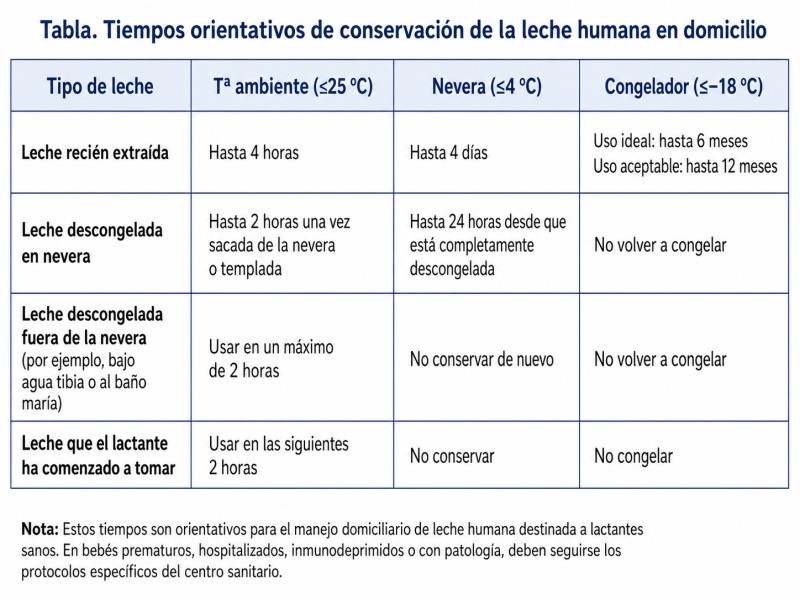
Tabla 3. de tiempos
5.3 MANEJO DE LA LECHE HUMANA
Elegiremos para utilizar en primer lugar la leche fresca, en segundo lugar, la leche refrigerada y en tercer lugar la leche congelada y de ésta, comenzaremos utilizando la más antigua para evitar tener que tirarla si se pasa de la fecha válida de consumo.
Para descongelar la leche el manejo es similar al de otros alimentos congelados. Si se prevé cuándo se va a utilizar, se puede meter en el frigorífico y dejar descongelar lentamente. Pero si hay que utilizar la leche rápidamente, se puede descongelar en un “baño maría”. Aunque esa leche, si no se mete de inmediato en la nevera, se debe consumir en el momento. No se debe dejar a temperatura ambiente.
Por lo general, la leche descongelada puede mantenerse en el frigorífico durante las siguientes 24 horas. No se recomienda volver a congelarla en caso de no utilizarla en ese tiempo.
En ocasiones, al descongelar la leche se puede notar un olor o sabor rancio. Debemos explicar a las personas que van a manejar la leche que no es preocupante. Es un efecto de las lipasas (enzimas que degradan las grasas) presentes en la leche. Éstas han degradado las grasas descomponiéndolas y por eso se produce ese olor y sabor. La verdad es que los bebés no suelen mostrar ningún disgusto por que la leche sepa así. Aunque si el niño al que se le ofrece es más mayor puede que rechace la leche. Algunas mujeres pueden tener una actividad de la lipasa mayor que la de otras mujeres y su leche adquiere ese sabor rancio muy rápidamente después de extraerla y los bebés pueden rechazar el sabor. En esos casos, se ha visto que calentar la leche sin que llegue a hervir nada más extraerla y enfriarla rápidamente y congelarla a continuación, reduce la actividad de las lipasas disminuyendo el olor y el sabor desagradables de forma que los bebés ya no la rechazan.
La leche extraída se separa en 3 fases, quedando la grasa en la parte de arriba, así que antes de utilizarla se debe remover (no agitar) para homogeneizarla. Cuando se va a administrar al bebé no es necesario calentarla en exceso. De hecho, la mayoría de los niños la aceptan a temperatura ambiente sin problema. Así que se puede calentar en un “baño maría” sin ponerlo directamente en el fuego
En cuanto al uso del horno microondas para calentarla, no se recomienda por el riesgo de que el calentamiento no sea uniforme y se puedan producir quemaduras. Por ello, si se utiliza, se debe remover la leche para estar seguro de que se ha calentado de manera uniforme y dejarla reposar hasta que tenga la temperatura adecuada.
Para transportar leche materna, puede utilizarse una nevera portátil con acumuladores de frío. En estas condiciones, la leche puede mantenerse hasta 24 horas. Al llegar al destino, debe utilizarse, refrigerarse o congelarse según corresponda.
BIBLIOGRAFÍA
- Forster DA, Moorhead AM, Jacobs SE, Davis PG, Walker SP, McEgan KM, et al. Advising women with diabetes in pregnancy to express breastmilk in late pregnancy (Diabetes and Antenatal Milk Expressing [DAME]): a multicentre, unblinded, randomised controlled trial. Lancet [Internet]. 2017; 389:2204-13. Disponible en: http://dx.doi.org/10.1016/S0140-6736(17)31373-9" target="_blank">http://dx.doi.org/10.1016/S0140-6736(17)31373-9
- Wszolek K. Hand expressing in pregnancy and colostrum harvesting - Preparation for successful breastfeeding? Br J Midwifery. 2015;23(4):268-74.
- Morton J, Hall JY, Wong RJ, Thairu L, Benitz WE, Rhine WD. Combining hand techniques with electric pumping increases milk production in mothers of preterm infants. J Perinatol [Internet]. 2009; 29:757-64. Disponible en: http://dx.doi.org/10.1038/jp.2009.87" target="_blank">http://dx.doi.org/10.1038/jp.2009.87
- Asociación Enfermeras Registradas de Ontario. Lactancia Materna-Fomento y Apoyo al Inicio, la Exclusividad y la Continuación de la Lactancia Materna para Recién Nacidos, Lactantes y Niños Pequeños. 2018;208. Disponible en: http://www.evidenciaencuidados.es/es/attachments/article/46/D0015_Lactancia_Materna.pdf" target="_blank">http://www.evidenciaencuidados.es/es/attachments/article/46/D0015_Lactancia_Materna.pdf
- Asociación Española de Pediatría. Manual de lactancia materna. De la teoría a la práctica. Madrid: Editorial Médica Panamericana; 2008. 474 p.
- Calvo J, García Lara NR, Gormaz M, Peña M, Martínez Lorenzo MJ, Ortiz Murillo P, et al. Recomendaciones para la creación y el funcionamiento de los bancos de leche materna en España. An Pediatría. 2018;89(1):65. e1-65. e6.
- Eglash A, Simon L. ABM clinical protocol #8: Human milk storage information for home use for full-term Infants, Revised 2017. Breastfeed Med. 2017;12(7):390-5.
- Grupo de trabajo de la guía de práctica clínica sobre lactancia materna. Guía de Práctica Clínica sobre Lactancia Materna. Ministerior de Sanidad SS e I, Agencia de Evaluación de Tecnologías Sanitarias del Pais vasco-OSTEBA, editores. Guía de Práctica Clínica sobre Lactancia Materna. Guías de Práctica Clínica en el SNS; 2017.
- Kassing D. Bottle-Feeding as a Tool to Reinforce Breastfeeding. J Hum Lact [Internet]. 1 de febrero de 2002;18(1):56-60. Disponible en: http://journals.sagepub.com/doi/10.1177/089033440201800110" target="_blank">http://journals.sagepub.com/doi/10.1177/089033440201800110
- Mangel L, Ovental A, Batscha N, Arnon M, Yarkoni I, Dollberg S. Higher Fat Content in Breastmilk Expressed Manually: A Randomized Trial. Breastfeed Med. 2015;10(7):352-4.
- Lawrence RA, Lawrence RM. Lactancia materna. Una guía para la profesión médica. 6.a ed. Madrid: Elsevier España; 2007. 1234 p.
- Olza I. Dar el biberón como si fuera el pecho [Internet]. [citado 11 de octubre de 2021]. Disponible en: https://iboneolza.org/2012/08/02/dar-el-biberon-como-si-fuera-el-pecho/" target="_blank">https://iboneolza.org/2012/08/02/dar-el-biberon-como-si-fuera-el-pecho/
- Pados BF, Park J, Thoyre SM, Estrem H, Nix WB. Milk Flow Rates from bottle nipples used after hospital discharge. MCN Am J Matern Child Nurs [Internet]. 2016;41(4):237-43. Disponible en: http://www.ncbi.nlm.nih.gov/pubmed/27008466" target="_blank">http://www.ncbi.nlm.nih.gov/pubmed/27008466
- Peterson A, Harmer M. Balancing Breast & Bottle: Reaching Your Breastfeeding Goals. Plano. Texas: Hale Publishing; 2010. 169 p.
- Soltani H, Scott AMS. Antenatal breast expression in women with diabetes: outcomes from a retrospective cohort study. Int Breastfeed J [Internet]. 2012;7(18):1-5. Disponible en: http://www.internationalbreastfeedingjournal.com/content/7/1/18" target="_blank">http://www.internationalbreastfeedingjournal.com/content/7/1/18
- Sriraman NK, Evans AE, Lawrence RM, Noble L. Declaración de postura de 2017 de la Academia de Medicina de Lactancia Materna sobre la donación informal de leche materna para lactantes sanos nacidos a término. Breastfeed Med. 2017;13(1).
- Watson Genna C. Supporting Sucking Skills in Breastfeeding Infants. Woodhaven, NY: Jones and Bartlett Publishers; 2008. 355 p.
- West D, Marasco L. The Breastfeeding Mother’s Guide to Making More Milk. USA: McGraw-Hill; 2009. 278 p.
- Allen E, Rumbold AR, Keir A, Collins CT, Gillis J, Suganuma H. Avoidance of bottles during the establishment of breastfeeds in preterm infants. Cochrane Database Syst Rev. 2021;10(10):CD005252. doi:10.1002/14651858.CD005252.pub5.
- American Academy of Pediatric Dentistry. Policy on pacifiers. In: The Reference Manual of Pediatric Dentistry [Internet]. Chicago: American Academy of Pediatric Dentistry; 2025. p. 86-89 [cited 2026 May 1]. Available from: https://www.aapd.org/globalassets/media/policies_guidelines/p_pacifiers.pdf." target="_blank">https://www.aapd.org/globalassets/media/policies_guidelines/p_pacifiers.pdf.
- American Academy of Pediatrics. Promoting human milk and breastfeeding for the very low birth weight infant. Pediatrics. 2026;157(2):e2025073625.
- American Academy of Pediatrics. Tips for freezing & refrigerating breast milk [Internet]. Itasca (IL): American Academy of Pediatrics; 2025 Jul 7 [cited 2026 May 1]. Available from: https://www.healthychildren.org/English/ages-stages/baby/breastfeeding/Pages/Storing-and-Preparing-Expressed-Breast-Milk.aspx." target="_blank">https://www.healthychildren.org/English/ages-stages/baby/breastfeeding/Pages/Storing-and-Preparing-Expressed-Breast-Milk.aspx.
- Anders LA, Mesite Frem J, McCoy TP. Flange Size Matters: A Comparative Pilot Study of the Flange FITS™ Guide Versus Traditional Sizing Methods. J Hum Lact. 2025;41(1):55-65. doi:10.1177/08903344241296036.
- Aydin C, Aytekin Ozdemir A, Kahveci H. The effect of supplemental feeding tube device on time to transition to exclusive breastfeeding and discharge: a randomized controlled trial with preterm infants. Breastfeed Med. 2024;19(9). doi:10.1089/bfm.2024.0084.
- Bartick M, Hernández-Aguilar MT, Wight N, Mitchell KB, Simon L, Hanley L, et al. ABM Clinical Protocol #35: Supporting Breastfeeding During Maternal or Child Hospitalization. Breastfeed Med. 2021;16(9):664-674. doi:10.1089/bfm.2021.29190.mba.
- Bessell A, Hooper L, Shaw WC, Reilly S, Reid J, Glenny AM. Feeding interventions for growth and development in infants with cleft lip, cleft palate or cleft lip and palate. Cochrane Database Syst Rev. 2011;(2):CD003315. doi:10.1002/14651858.CD003315.pub3.
- Boies EG, Vaucher YE; Academy of Breastfeeding Medicine. ABM Clinical Protocol #10: Breastfeeding the late preterm and early term infants, second revision 2016. Breastfeed Med. 2016;11(10):494-500. doi:10.1089/bfm.2016.29031.egb.
- Buldur E, Yalcin Baltaci N, Terek D, Kucukoglu S. Comparison of the finger feeding method versus syringe feeding method in supporting sucking skills of preterm babies. Breastfeed Med. 2020;15(11):703-708. doi:10.1089/bfm.2020.0043.
- Cecilio JO, MendonçaVieira FV, Oliveira FS, Guimarães JV, Aredes NDA, Evangelista DR, et al. Breast shells for pain and nipple injury prevention: a non-randomized clinical trial. PEC Innov. 2022;1:100101. doi:10.1016/j.pecinn.2022.100101.
- Çelik F, Şen S, Karayagız Muslu G. Effects of oral stimulation and supplemental nursing system on the transition time to full breast of mother and sucking success in preterm infants: a randomized controlled trial. Clin Nurs Res. 2022;31(5):891-900. doi:10.1177/10547738211058312.
- Centers for Disease Control and Prevention. Breast milk storage and preparation [Internet]. Atlanta: CDC; 2026 Mar 25 [cited 2026 May 2]. Available from: https://www.cdc.gov/breastfeeding/breast-milk-preparation-and-storage/handling-breastmilk.html." target="_blank">https://www.cdc.gov/breastfeeding/breast-milk-preparation-and-storage/handling-breastmilk.html.
- Centers for Disease Control and Prevention. How to clean and sanitize breast pumps [Internet]. Atlanta: CDC; 2024 Sep 12 [cited 2026 May 2]. Available from: https://www.cdc.gov/hygiene/about/about-breast-pump-hygiene.html." target="_blank">https://www.cdc.gov/hygiene/about/about-breast-pump-hygiene.html.
- Centers for Disease Control and Prevention. Providing care for babies to sleep safely [Internet]. Atlanta: CDC; 2024 [cited 2026 May 1]. Available from: https://www.cdc.gov/sudden-infant-death/sleep-safely/index.html." target="_blank">https://www.cdc.gov/sudden-infant-death/sleep-safely/index.html.
- Chawanpaiboon S, Anuwutnavin S, Pooliam J. Effect of nipple shield use on exclusive breastfeeding up to 6 months in mothers with nipple abnormalities: a randomized controlled trial. Int J Womens Health. 2026;18:601072. doi:10.2147/IJWH.S601072.
- Chow S, Chow R, Popovic M, Lam H, Merrick J, Ventegodt S, et al. The use of nipple shields: a review. Front Public Health. 2015;3:236. doi:10.3389/fpubh.2015.00236.
- Coentro VS, Lai CT, Rea A, Turlach B, Geddes DT, Perrella SL. Breast milk production in women who use nipple shields for persistent nipple pain. J Obstet Gynecol Neonatal Nurs. 2022;51(1):73-82. doi:10.1016/j.jogn.2021.09.005.
- Coentro VS, Perrella SL, Lai CT, Rea A, Dymock M, Geddes DT. Nipple shield use does not impact sucking dynamics in breastfeeding infants of mothers with nipple pain. Eur J Pediatr. 2021;180(5):1537-1543. doi:10.1007/s00431-020-03901-3.
- Coentro VS, Perrella SL, Lai CT, Rea A, Murray K, Geddes DT. Impact of nipple shield use on milk transfer and maternal nipple pain. Breastfeed Med. 2021;16(3):222-229. doi:10.1089/bfm.2020.0110.
- Colbenson GA, Mehta SG, Nassar A, Boelig RC, Stuebe AM. The impact of wearable breast pumps on physicians returning to work after maternity leave. J Grad Med Educ. 2022;14(2):195-200. doi:10.4300/JGME-D-21-00627.1.
- Cunha BML, Badarane EBL, Sousa Filho PVM, Costa KM, Silva Filho MD. Dysfunctional suction dynamics in newborns with ankyloglossia. Codas. 2023 Nov 10;36(2):e20230054. doi:10.1590/2317-1782/20232023054. PMID:39536166; PMCID:PMC10727230.
- D’Hollander CJ, McCredie VA, Uleryk EM, Keown-Stoneman CDG, Birken CS, Borkhoff CM, et al. Breastfeeding Support Provided by Lactation Consultants: A Systematic Review and Meta-Analysis. JAMA Pediatr. 2025;179(5):508-520. doi:10.1001/jamapediatrics.2024.6810.
- Davis A, et al. The impact of Holder pasteurization on macronutrients, micronutrients, and bioactive components of donor human milk. J Pediatr Gastroenterol Nutr. 2025.
- Demir Barbak Z, Kurudirek F, Kahveci H. The effect of non-nutritive finger feeding by fathers on the transition to breastfeeding and sucking success in premature infants: a randomized controlled trial. Breastfeed Med. 2026;21(2):129-137. doi:10.1177/15568253251400348.
- Department of Health and Social Care, UNICEF UK Baby Friendly Initiative. Guide to bottle feeding [Internet]. London: Department of Health and Social Care; 2022 [cited 2026 May 1]. Available from: https://www.unicef.org.uk/babyfriendly/baby-friendly-resources/bottle-feeding-resources/guide-to-bottle-feeding/" target="_blank">https://www.unicef.org.uk/babyfriendly/baby-friendly-resources/bottle-feeding-resources/guide-to-bottle-feeding/
- Donovan TJ, Buchanan K. Medications for increasing milk supply in mothers expressing breastmilk for their preterm hospitalised infants. Cochrane Database Syst Rev. 2021;11(11):CD005544. doi:10.1002/14651858.CD005544.pub2.
- dos Santos DA, Giugliani C, Bizon AMBL, Giugliani ERJ. Nipple shield use in the maternity ward increases risk of exclusive breastfeeding interruption in the first six months of infant’s life. Midwifery. 2024;128:103873. doi:10.1016/j.midw.2023.103873.
- Eglash A, Simon L, The Academy of Breastfeeding Medicine. ABM Clinical Protocol #8: Human Milk Storage Information for Home Use for Full-Term Infants, Revised 2017. Breastfeed Med. 2017;12(7):390-395. doi:10.1089/bfm.2017.29047.aje.
- Ferreiro Tiemblo E. Donación de leche materna en madres tras una pérdida perinatal: beneficios sobre su salud mental. Rev Esp Enferm Salud Mental. 2024;(21).
- Foong SC, Tan ML, Foong WC, Marasco LA, Ho JJ, Ong JH. Oral galactagogues for increasing breast-milk production in mothers of non-hospitalised term infants. Cochrane Database Syst Rev. 2020;5(5):CD011505. doi:10.1002/14651858.CD011505.pub2.
- Forster DA, Moorhead AM, Jacobs SE, Davis PG, Walker SP, McEgan KM, et al. Advising women with diabetes in pregnancy to express breastmilk in late pregnancy (Diabetes and Antenatal Milk Expressing [DAME]): a multicentre, unblinded, randomised controlled trial. Lancet. 2017;389(10085):2204-2213. doi:10.1016/S0140-6736(17)31373-9.
- Foster JP, Psaila K, Patterson T. Non-nutritive sucking for increasing physiologic stability and nutrition in preterm infants. Cochrane Database of Systematic Reviews 2016, Issue 10. Art. No.: CD001071. doi:10.1002/14651858.CD001071.pub3. Accedida el 27 de abril de 2026.
- Fu ZY, Huang C, Lei L, Chen LC, Wei LJ, Zhou J, et al. The effect of oropharyngeal colostrum administration on the clinical outcomes of premature infants: a meta-analysis. Int J Nurs Stud. 2023;144:104527. doi:10.1016/j.ijnurstu.2023.104527.
- Garcia DS, Garcia KW. Pacifiers: Common Questions and Answers. Am Fam Physician. 2025 Mar;111(3):230-235. PMID:40106289.
- Gozen D, Çiftci HB, Atli N, Bozdag F, Avlanmis ME. Effect of the supplemental nursing system on the oral feeding skills of preterm infants: a randomized controlled study. Am J Speech Lang Pathol. 2025;34(6):3389-3399. doi:10.1044/2025_AJSLP-25-00027.
- Gridneva Z, Warden AH, McEachran JL, Lai CT, Perrella SL, Geddes DT. A comparison of the efficacy and comfort of traditional and a hands-free, in-bra breastmilk collection pump sets. Proceedings. 2023;93(1):12. doi:10.3390/proceedings2023093012.
- Gridneva Z, Warden AH, McEachran JL, Lai CT, Perrella SL, Geddes DT. Efficacy assessment of the breast shield size. Proceedings. 2025;112(1):7. doi:10.3390/proceedings2025112007.
- Gridneva Z, Warden AH, McEachran JL, Lai CT, Perrella SL, Geddes DT. Human milk expression technologies: an evaluation of efficacy and comfort of hands-free, in-bra, breastmilk collection pump set. Clin Nutr Open Sci. 2023;49:28-36. doi:10.1016/j.nutos.2023.04.002.
- Gülbetekin E, Gül Can F. The effect of supplemental nursing system on sucking success, weight gain findings and bilirubin level in newborns: a randomized controlled trial. Matern Child Health J. 2025;29(2):258-268. doi:10.1007/s10995-025-04039-0.
- Human Milk Banking Association of North America. HMBANA Standards for Donor Human Milk Banking: An Overview. HMBANA; 2024.
- Ito M, Tanaka M, Date M, Miura K, Mizuno K. Possibility of microwave thawing of human milk: effects on milk composition and temperature distribution. J Hum Lact. 2025;41(4):587-596. doi:10.1177/08903344251365640.
- Jaafar SH, Ho JJ, Jahanfar S, Angolkar M. Effect of restricted pacifier use in breastfeeding term infants for increasing duration of breastfeeding. Cochrane Database of Systematic Reviews 2016, Issue 8. Art. No.: CD007202. doi:10.1002/14651858.CD007202.pub4. Accedida el 27 de abril de 2026.
- Jack A, Brown A, Bunik M, Chantry C, Marinelli KA, Noble L, et al. Academy of Breastfeeding Medicine Clinical Protocol #19: Breastfeeding Promotion in the Prenatal Period (Revised 2024). Breastfeed Med. 2024;19(8):575-587. doi:10.1089/bfm.2024.0203.
- Jasovic MO. Antenatal colostrum expression: are we interfering with nature? Int Breastfeed J. 2025;20:87. doi:10.1186/s13006-025-00766-w.
- Johnsen M, Klingenberg C, Brand PLP, Størdal K. Antenatal breastmilk expression for women with diabetes in pregnancy: a feasibility study. Int Breastfeed J. 2021;16(1):45. doi:10.1186/s13006-021-00393-1.
- Kalathingal T, Manerkar S, Mondkar J, Kalamdani P, Patra S, Kaur S, et al. Comparison of two pumping strategies to improve exclusive breastfeeding at discharge in mothers of very low birth weight infants with low milk output: a pilot randomized controlled trial. Indian J Pediatr. 2024;91(9):906-912. doi:10.1007/s12098-023-04859-4.
- Kassing D. Bottle-feeding as a tool to reinforce breastfeeding. J Hum Lact. 2002;18(1):56-60. doi:10.1177/089033440201800110.
- Kavanagh J, Kelly AJ, Thomas J. Breast stimulation for cervical ripening and induction of labour. Cochrane Database Syst Rev. 2005;(3):CD003392. doi:10.1002/14651858.CD003392.pub2.
- Kellams A, Harrel C, Omage S, Gregory C, Rosen-Carole C; Academy of Breastfeeding Medicine. ABM Clinical Protocol #3: supplementary feedings in the healthy term breastfed neonate, revised 2017. Breastfeed Med. 2017;12(3):188-198. doi:10.1089/bfm.2017.29038.ajk.
- Kotowski J, Fowler C, Hourigan C, Orr F. Bottle-feeding an infant feeding modality: an integrative literature review. Matern Child Nutr. 2020;16(2):e12939. doi:10.1111/mcn.12939.
- Kronborg H, Foverskov E, Nilsson I, Maastrup R. Why do mothers use nipple shields and how does this influence duration of exclusive breastfeeding? Matern Child Nutr. 2017;13(1):e12251. doi:10.1111/mcn.12251.
- LactApp. Métodos de extracción poderosa [Internet]. Barcelona: LactApp; 2018 Jan 29 [cited 2026 May 2]. Available from: https://blog.lactapp.es/metodos-extraccion-poderosa/" target="_blank">https://blog.lactapp.es/metodos-extraccion-poderosa/
- McKechnie AC, Eglash A. Nipple shields: a review of the literature. Breastfeed Med. 2010;5(6):309-314. doi:10.1089/bfm.2010.0003.
- Meier PP, Brown LP, Hurst NM, Spatz DL, Engstrom JL, Borucki LC, et al. Nipple shields for preterm infants: effect on milk transfer and duration of breastfeeding. J Hum Lact. 2000;16(2):106-114.
- Meier PP, Patel AL, Bigger HR, Rossman B, Engstrom JL. Supporting breastfeeding in the neonatal intensive care unit: Rush Mother’s Milk Club as a case study of evidence-based care. Pediatr Clin North Am. 2013;60(1):209-226. doi:10.1016/j.pcl.2012.10.007.
- Mitchell KB, Johnson HM, Rodríguez JM, Eglash A, Scherzinger C, Zakarija-Grkovic I, et al. Academy of Breastfeeding Medicine Clinical Protocol #36: The Mastitis Spectrum, Revised 2022. Breastfeed Med. 2022;17(5):360-376. doi:10.1089/bfm.2022.29207.kbm.
- Moon RY, Carlin RF, Hand I; Task Force on Sudden Infant Death Syndrome and the Committee on Fetus and Newborn. Sleep-related infant deaths: updated 2022 recommendations for reducing infant deaths in the sleep environment. Pediatrics. 2022;150(1):e2022057990. doi:10.1542/peds.2022-057990.
- Moorhead AM, Amir LH, Crawford SB, Forster DA. Breastfeeding outcomes at 3 months for women with diabetes in pregnancy: Findings from the Diabetes and Antenatal Milk Expressing randomized controlled trial. Birth. 2024;51:508-520. doi:10.1111/birt.12807.
- Moro GE, Billeaud C, Rachel B, et al. New alternatives to Holder pasteurization in processing donor human milk. Front Nutr. 2024.
- Morton J, Hall JY, Wong RJ, Thairu L, Benitz WE, Rhine WD. Combining hand techniques with electric pumping increases milk production in mothers of preterm infants. J Perinatol. 2009;29(11):757-764. doi:10.1038/jp.2009.87.
- Morton J, Wong RJ, Hall JY, Pang WW, Lai CT, Lui J, et al. Combining hand techniques with electric pumping increases the caloric content of milk in mothers of preterm infants. J Perinatol. 2012;32(10):791-796. doi:10.1038/jp.2011.195.
- National Library of Medicine. Ibuprofen. In: Drugs and Lactation Database (LactMed) [Internet]. Bethesda (MD): National Institute of Child Health and Human Development; 2006- [updated 2025 Aug 15; cited 2026 May 2]. Available from: https://www.ncbi.nlm.nih.gov/books/NBK500986/" target="_blank">https://www.ncbi.nlm.nih.gov/books/NBK500986/
- NHS Health Scotland. Formula feeding: how to feed your baby safely [Internet]. Edinburgh: NHS Health Scotland; [cited 2026 May 1]. Available from: https://www.healthscotland.com/" target="_blank">https://www.healthscotland.com/
- O’Sullivan TA, Cooke J, McCafferty C, Amir LH. A brief history of antenatal colostrum expression, and where to from here. Proc Nutr Soc. 2025;84(1):1-10. doi:10.1017/S0029665124007985.
- Pados BF, Camp L. Physiology of human lactation and strategies to support milk supply for breastfeeding. Nurs Womens Health. 2024;28(4):303-314. doi:10.1016/j.nwh.2024.01.007.
- Pados BF. Milk flow rates from bottle nipples: what we know and why it matters. Nurs Womens Health. 2021;25(3):229-235. doi:10.1016/j.nwh.2021.03.006.
- Penny C, McGuire C, Bezuhly M. A systematic review of feeding interventions for infants with cleft palate. Cleft Palate Craniofac J. 2022;59(12):1527-1536. doi:10.1177/10556656211051216.
- Penny F, Brownell EA, Judge M, Marshall-Crim M, Cartagena D, McGrath JM. Use of a supplemental feeding tube device and breastfeeding at 4 weeks. MCN Am J Matern Child Nurs. 2023;48(6):334-340. doi:10.1097/NMC.0000000000000962.
- Peres KG, Cascaes AM, Nascimento GG, Victora CG. Effect of breastfeeding on malocclusions: a systematic review and meta-analysis. Acta Paediatr. 2015;104(467):54-61. doi:10.1111/apa.13103.
- Pillay J, Davis TJ. Physiology, Lactation. In: StatPearls [Internet]. Treasure Island (FL): StatPearls Publishing; 2023 [cited 2026 May 2]. Available from: https://www.ncbi.nlm.nih.gov/books/NBK499981/" target="_blank">https://www.ncbi.nlm.nih.gov/books/NBK499981/
- Quigley M, Embleton ND, Meader N, McGuire W. Donor human milk for preventing necrotising enterocolitis in very preterm or very low-birthweight infants. Cochrane Database Syst Rev. 2024;(9):CD002971.
- Sadoun C, Templier L, Alloul L, Rossi C, Renovales ID, Sanchez IN, Sahagún PM. Effects of non-nutritive sucking habits on malocclusions: a systematic review. J Clin Pediatr Dent. 2024 Mar;48(2):4-18. doi:10.22514/jocpd.2024.029. Epub 2024 Mar 3. PMID:38548628.
- Sakalidis VS, Mitoulas LR, Lai CT, Kent JC, Prime DK, Geddes DT. Breast shield design impacts milk removal dynamics during pumping: A randomized controlled non-inferiority trial. Acta Obstet Gynecol Scand. 2020;99(12):1561-1569. doi:10.1111/aogs.13939.
- Sexton S, Natale R. Risks and benefits of pacifiers. Am Fam Physician. 2009;79(8):681-685. PMID:19405412.
- Shah R, Sabir S, Alhawaj AF. Physiology, Breast Milk. In: StatPearls [Internet]. Treasure Island (FL): StatPearls Publishing; 2022 [cited 2026 May 2]. Available from: https://www.ncbi.nlm.nih.gov/books/NBK539790/" target="_blank">https://www.ncbi.nlm.nih.gov/books/NBK539790/
- Shaki F, Aziznejadroshan P, Rad ZA, Chehrazi M, Arzani A. Comparison of the effect of two methods of sucking on pacifier and mother's finger on oral feeding behavior in preterm infants: a randomized clinical trial. BMC Pediatr. 2022 May 18;22(1):292. doi:10.1186/s12887-022-03352-9. PMID:35585519; PMCID:PMC9118858.
- Sheffield V, et al. A wearable lactation pump pilot for graduate medical education trainees. J Grad Med Educ. 2024. doi:10.4300/JGME-D-23-00754.1.
- Sobik S, Crimmins M, Hand M, Blake L, Andres A. Education and experiences of antenatal breast milk expression: A systematic review. Breastfeed Med. 2023;18(2):107-115. doi:10.1089/bfm.2022.0225.
- Spatz DL. Having enough milk to sustain a lactation journey. Nurs Womens Health. 2024;28(4):315-323. doi:10.1016/j.nwh.2024.04.005.
- Sriraman NK, Evans AE, Lawrence R, et al. Academy of Breastfeeding Medicine’s 2017 Position Statement on informal breast milk sharing for the term healthy infant. Breastfeed Med. 2018;13(1):2-4.
- Tolppola O, Renko M, Sankilampi U, Kiviranta P, Hintikka L, Kuitunen I. Pacifier use and breastfeeding in term and preterm newborns-a systematic review and meta-analysis. Eur J Pediatr. 2022 Sep;181(9):3421-3428. doi:10.1007/s00431-022-04559-9. Epub 2022 Jul 14. PMID:35834044; PMCID:PMC9395499.
- Truong P, Walsh E, Scott VP, Coleman T, Tilvawala G, Friend J. Non-Nutritive Suckling System for Real-Time Characterization of Intraoral Vacuum Profile in Full Term Neonates. IEEE J Transl Eng Health Med. 2022 Dec 23;11:107-115. doi:10.1109/JTEHM.2022.3231788. PMID:36619906; PMCID:PMC9815562.
- UNICEF UK Baby Friendly Initiative. Responsive feeding infosheet: supporting close and loving relationships [Internet]. London: UNICEF UK; [cited 2026 May 1]. Available from: https://www.unicef.org.uk/babyfriendly/baby-friendly-resources/relationship-building-resources/responsive-feeding-infosheet/" target="_blank">https://www.unicef.org.uk/babyfriendly/baby-friendly-resources/relationship-building-resources/responsive-feeding-infosheet/
- United Kingdom Committee for UNICEF. Infant formula and responsive bottle feeding: a guide for parents [Internet]. London: UNICEF UK; 2024 [cited 2026 May 1]. Available from: https://www.unicef.org.uk/babyfriendly/baby-friendly-resources/bottle-feeding-resources/infant-formula-responsive-bottle-feeding-guide-for-parents/" target="_blank">https://www.unicef.org.uk/babyfriendly/baby-friendly-resources/bottle-feeding-resources/infant-formula-responsive-bottle-feeding-guide-for-parents/
- Ventura AK, Drewelow VM, Richardson TN. Does paced bottle-feeding improve the quality and outcome of bottle-feeding interactions? Early Hum Dev. 2025;201:106181. doi:10.1016/j.earlhumdev.2024.106181.
- Ventura AK, Keim SA, Ades V, Bostic N. Knowledge and use of paced bottle-feeding among mothers of young infants. J Nutr Educ Behav. 2023;55(11):796-802. doi:10.1016/j.jneb.2023.08.002.
- West D, Marasco L. Making More Milk: The Breastfeeding Guide to Increasing Your Milk Production. 2nd ed. New York: McGraw Hill; 2020.
- Wood NK, Odom-Maryon T, Smart DA. Factors associated with exclusive direct breastfeeding in the first 3 months. Nurs Womens Health. 2022;26(4):299-307. doi:10.1016/j.nwh.2022.05.006.
- World Health Organization, UNICEF. Implementation guidance: protecting, promoting and supporting breastfeeding in facilities providing maternity and newborn services: the revised Baby-friendly Hospital Initiative 2018 [Internet]. Geneva: World Health Organization; 2018 [cited 2026 May 1]. Available from: https://www.who.int/publications/i/item/9789241513807." target="_blank">https://www.who.int/publications/i/item/9789241513807.
- World Health Organization, United Nations Children’s Fund. Protecting, promoting and supporting breastfeeding: the Baby-friendly Hospital Initiative for small, sick and preterm newborns [Internet]. Geneva: WHO; 2020 [cited 2026 May 1]. Available from: https://www.who.int/publications/i/item/9789240005648." target="_blank">https://www.who.int/publications/i/item/9789240005648.
- World Health Organization. Cup-feeding for low-birth-weight infants unable to fully breastfeed [Internet]. Geneva: WHO; 2023 [cited 2026 May 1]. Available from: https://www.who.int/tools/elena/interventions/cupfeeding-infants." target="_blank">https://www.who.int/tools/elena/interventions/cupfeeding-infants.
- World Health Organization. Donor human milk for low-birth-weight infants. WHO; 2023.